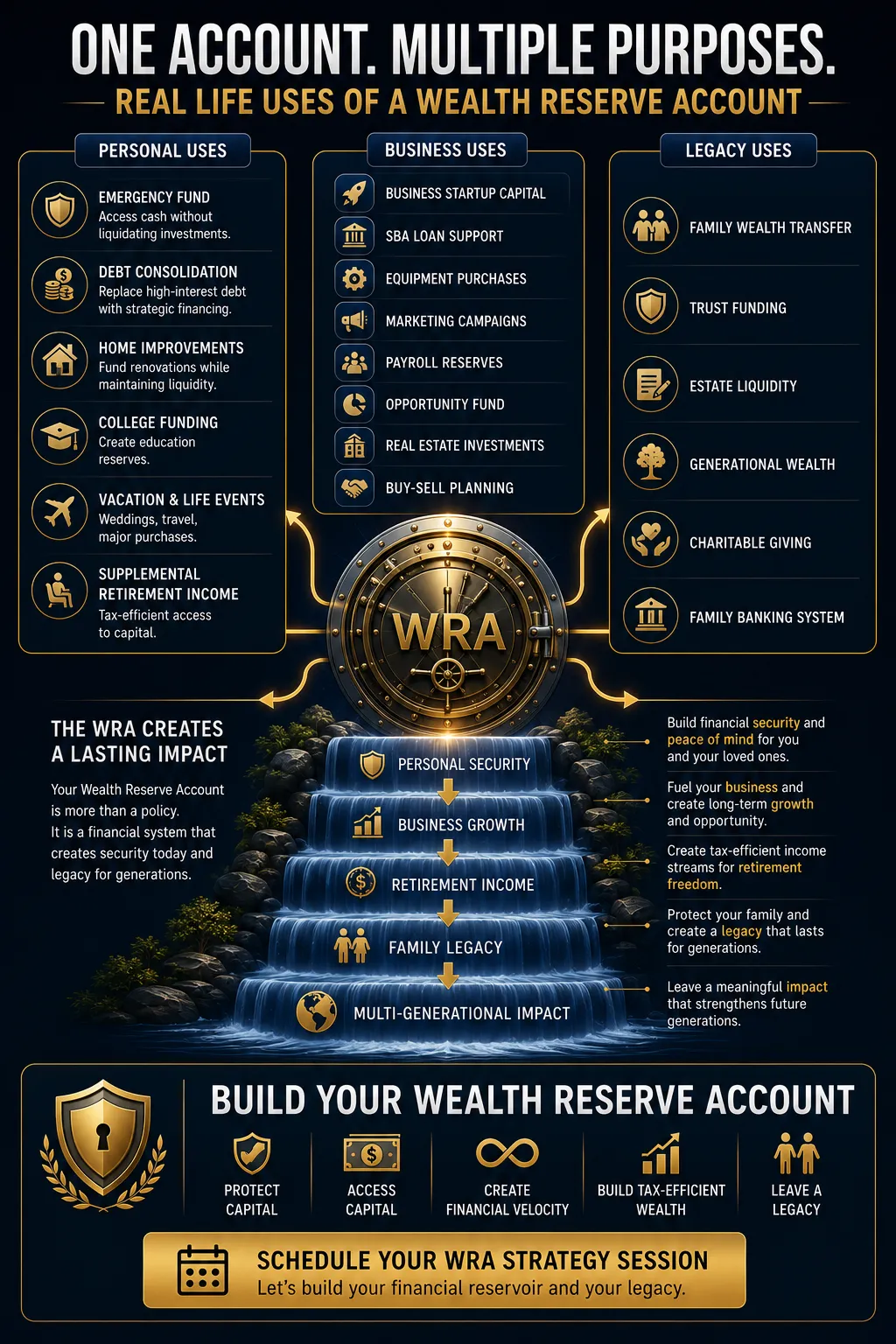
How Can You Use a Wealth Reserve Account? Real-Life WRA Strategies for Personal, Business, Retirement, and Legacy Planning
What are some of the ways you can use a Wealth Reserve Account, or WRA?
One of the most important things to understand about a Wealth Reserve Account is that it is designed to serve multiple financial purposes.
A properly designed WRA can potentially help you create:
- Personal financial security
- Emergency reserves
- Debt-repayment strategies
- Business liquidity
- Opportunity capital
- Retirement flexibility
- Family wealth transfer
- Generational legacy planning
Your Wealth Reserve Account is more than a policy. It can become a financial system that creates security today and legacy for generations.
What Is a Wealth Reserve Account?
A Wealth Reserve Account (WRA) is a specially designed whole life insurance strategy typically structured with a dividend-paying mutual insurance company and designed with an emphasis on high cash value.
As the policy develops, it can provide:
- Permanent life insurance protection
- Contractual cash value
- Potential dividends
- Liquidity
- Policy-loan access
- Tax advantages under current law
- Financial flexibility
- Legacy protection
The goal is to build a reserve that you can potentially access throughout your lifetime while maintaining permanent protection and long-term value.
One Account, Multiple Purposes
The strength of the Wealth Reserve Account strategy is that one properly designed financial asset may potentially support multiple areas of your life.
PERSONAL → BUSINESS → RETIREMENT → LEGACY
Personal: Build security and maintain access to capital.
Business: Create liquidity and capital for opportunities.
Retirement: Build another potential source of tax-advantaged cash flow.
Legacy: Transfer wealth and create a financial foundation for future generations.
Personal Uses of a Wealth Reserve Account
Your WRA can potentially become part of the financial foundation you use for everyday life, major purchases, emergencies, and long-term planning.
1. Use Your WRA as an Emergency Fund
Build a Financial Reserve for the Unexpected
An emergency fund is designed to protect you from unexpected financial events.
Depending on your circumstances, many people choose to maintain several months of essential expenses or income as an emergency reserve.
Instead of keeping every long-term reserve dollar in a traditional savings account, some individuals may choose to build part of their reserve inside a properly designed high-cash-value whole life insurance policy.
Once sufficient cash value exists, available capital may potentially be accessed through a policy loan when an emergency occurs.
Examples might include:
- Unexpected medical expenses
- Loss of income
- Major home repairs
- Family emergencies
- Unexpected travel
- Temporary business disruptions
- Major automobile repairs
The goal is to build a reserve before the emergency happens, so you have another source of liquidity when you need it.
What Happens When You Borrow Against Your WRA?
When sufficient cash value is available, a policy owner may be able to access capital through a policy loan.
Policy loans generally use the policy's cash value as collateral.
Unlike many conventional loans, policy loans generally do not require:
- A traditional credit check
- A conventional loan application
- A traditional monthly amortization schedule
- Traditional income verification
Repayment provisions can also be more flexible than conventional bank debt, depending on the policy contract.
However, policy loans accrue interest and can reduce available cash value and death benefits if not properly managed.
2. Use Your WRA for Debt Consolidation
Another potential use of a Wealth Reserve Account is debt consolidation or debt restructuring.
Imagine that you have high-interest consumer debt.
If sufficient policy cash value is available, you may potentially borrow against your policy and use those proceeds to pay down or eliminate higher-cost debt.
HIGH-INTEREST DEBT → POLICY LOAN → FREED CASH FLOW → REPAY & REPLENISH
The objective is not simply to move debt from one account to another.
The objective is to improve your overall financial efficiency.
If eliminating the higher-cost debt reduces your monthly payments, that newly available cash flow may potentially be redirected toward repaying the policy loan and rebuilding available borrowing capacity.
Debt-to-Wealth Transfer
I refer to this concept as a Debt-to-Wealth Transfer.
The idea is to redirect money that was previously being consumed by debt toward building long-term financial assets and reserves.
Instead of:
INCOME → DEBT PAYMENT → MONEY GONE
The goal is to move toward:
INCOME → DEBT ELIMINATION → FREED CASH FLOW → ASSET BUILDING
The goal is not only to become debt-free. The goal is to redirect former debt payments toward building wealth.
3. Use Your WRA for Home Improvements
Available policy-loan proceeds may also be used for home improvements.
Examples could include:
- Kitchen remodeling
- Bathroom renovations
- Roof replacement
- Adding a pool
- Outdoor improvements
- Major repairs
- Energy upgrades
- Home additions
Rather than automatically turning to a credit card, personal loan, or other outside financing source, available WRA cash value may provide another potential source of capital.
4. Use Your WRA for College Funding
A Wealth Reserve Account may also be considered as part of a broader college-funding strategy.
Unlike accounts specifically restricted to qualified education expenses, policy-loan proceeds generally are not restricted to one specific category of spending.
That means available capital may potentially be used for:
- Tuition
- Housing
- Books
- Transportation
- Study abroad
- Graduate school
- Trade school
- Other education-related expenses
That flexibility may be valuable for families who want more control over how and when education capital is deployed.
However, college savings vehicles and life insurance have different features, costs, risks, and tax treatment, so they should be evaluated based on the family's overall goals.
5. Use Your WRA for Vacations and Life Events
Policy-loan proceeds are generally not restricted to emergency or investment uses.
Available capital may potentially be used for major life events such as:
- Weddings
- Family travel
- Vacations
- Major purchases
- Celebrations
- Vehicle purchases
- Other important life experiences
The bigger principle is that you have built a financial reserve before the expense occurs.
6. Use Your WRA as Part of Your Retirement Strategy
A properly structured Wealth Reserve Account may also become one component of a broader retirement-income strategy.
In later years, accumulated cash value may potentially provide another source of liquidity.
Depending on how the policy is structured and managed, policy loans may potentially provide tax-advantaged access to policy values.
Some policy owners may choose to repay those loans during retirement.
Others may choose to leave an outstanding balance and allow the remaining death benefit to settle the loan at death.
Any outstanding loan balance and accrued interest are generally deducted from the death benefit before the remaining proceeds are paid to beneficiaries.
WRA Retirement Income and Tax Efficiency
Life insurance receives unique treatment under the tax code.
Cash value generally grows on a tax-deferred basis.
Properly managed withdrawals and policy loans may provide tax-advantaged access to policy values.
However, tax consequences can occur if a policy is surrendered, lapses with a gain, becomes a Modified Endowment Contract, or is otherwise improperly structured or managed.
A WRA can potentially supplement retirement income, but policy design and management matter.
Business Uses of a Wealth Reserve Account
Wealth Reserve Accounts can also potentially provide significant flexibility for business owners and entrepreneurs.
Business owners often need capital quickly.
A WRA can potentially create another pool of private liquidity that may be used for both protection and business opportunities.
7. Use Your WRA to Start or Grow a Business
Available policy cash value may potentially be used as a source of business capital.
Potential uses include:
- Starting a new business
- Opening a new location
- Buying inventory
- Hiring employees
- Launching a new product
- Expanding operations
- Funding working capital
WRA → BUSINESS CAPITAL → BUSINESS GROWTH → CASH FLOW → REPAY WRA
8. Use Cash Value as Collateral for Business Financing
Cash value life insurance may also be accepted by certain lenders as collateral in connection with business financing.
For example, life insurance may sometimes be involved in SBA loan transactions, depending on the loan structure, lender requirements, and circumstances of the borrower.
A collateral assignment of life insurance may allow a lender to obtain a security interest in policy benefits while the policy remains owned by the policy owner.
Specific SBA and lender requirements vary, so the transaction should be reviewed with the appropriate lender and insurance professionals.
9. Use Your WRA for Equipment Purchases
Business equipment can require significant capital.
Available policy-loan proceeds may potentially provide another source of liquidity for:
- Machinery
- Commercial vehicles
- Computers
- Technology
- Office equipment
- Restaurant equipment
- Construction equipment
- Other business assets
10. Use Your WRA for Marketing Campaigns
Business growth often requires investing before the resulting revenue arrives.
A business owner with sufficient WRA cash value may potentially use policy-loan proceeds for:
- Advertising
- Digital marketing
- Direct mail
- Lead generation
- Events
- Brand development
- Sales campaigns
If the campaign generates profitable revenue, a portion of those proceeds can potentially be used to repay the policy loan.
11. Use Your WRA as a Payroll Reserve
Payroll is one of the most important responsibilities of a business owner.
Building a private capital reserve can potentially provide additional liquidity during:
- Seasonal slow periods
- Temporary cash-flow shortages
- Unexpected disruptions
- Delayed receivables
- Growth periods
A WRA can potentially become another source of liquidity when operating cash flow becomes temporarily constrained.
12. Use Your WRA as a Business Opportunity Fund
The best business opportunities rarely arrive at the perfect time.
Maintaining liquidity gives you options.
A business opportunity fund may potentially be used for:
- Acquisitions
- Partnership opportunities
- Discounted inventory
- Real estate
- New equipment
- Expansion
- Unexpected strategic opportunities
Opportunity favors the person who has access to capital when the opportunity arrives.
13. Use Your WRA for Real Estate Investing
Real estate investors may potentially use available policy value as one source of liquidity for property-related needs.
Examples could include:
- Down payments
- Closing costs
- Renovations
- Repairs
- Property improvements
- Short-term investment opportunities
- Bridge capital
Borrowing against a life insurance policy to invest involves leverage, so the risks, expected returns, loan interest, and repayment strategy should be evaluated carefully.
14. Use a WRA for Key Person Planning
A key person is someone whose death could create a significant financial loss for a business.
That person might be:
- An owner
- A founder
- A senior executive
- A top salesperson
- A technical expert
- Another employee critical to the business
With key-person life insurance, the business may own the policy and receive the death benefit if the insured key person dies, subject to applicable tax and legal requirements.
If the policy is structured as a cash-value whole life policy, it may potentially provide both:
- Key-person death benefit protection
- Accumulating cash value that may potentially be accessed during the insured's lifetime
One policy may potentially provide protection, cash value, liquidity, and long-term business planning benefits.
15. Use Life Insurance in Buy-Sell Planning
Life insurance is also commonly considered when funding certain buy-sell agreements.
A buy-sell agreement can establish what happens to an owner's business interest after certain triggering events such as death.
Life insurance may provide capital that helps the remaining owners or business purchase the deceased owner's interest according to the agreement.
A properly structured cash-value policy may also provide additional long-term value while the insured owners remain alive.
Legacy Uses of a Wealth Reserve Account
The Wealth Reserve Account is not only designed around what your money can do during your lifetime.
It can also help determine what happens to your wealth after you are gone.
16. Use Your WRA for Family Wealth Transfer
Permanent life insurance is designed to provide a death benefit to beneficiaries when the insured dies.
Under current federal tax law, life insurance death benefits are generally received income-tax-free by beneficiaries, subject to applicable exceptions.
This can make permanent life insurance a powerful component of a broader family wealth-transfer strategy.
BUILD DURING LIFE → ACCESS DURING LIFE → TRANSFER AT DEATH
17. Make a Trust the Beneficiary
Depending on your estate-planning strategy, a trust may potentially be named as beneficiary of a life insurance policy.
Instead of death-benefit proceeds being distributed directly to an individual beneficiary, the proceeds can potentially flow into a trust and be managed according to the terms established in the trust document.
This can potentially provide greater control over:
- When money is distributed
- How money is distributed
- Who receives the money
- How future generations access family wealth
- How assets are managed after death
Trust ownership and beneficiary designations can have significant legal, tax, and estate consequences, so they should be coordinated with qualified legal and tax professionals.
18. Create a Family Banking System
A broader family wealth strategy may use life insurance, trusts, family governance, and financial education together.
The objective is to move beyond simply leaving money to the next generation.
Instead, the family can establish principles governing how wealth should be preserved, accessed, invested, and transferred.
This may include a Family Constitution that defines expectations and principles for the family's financial legacy.
FAMILY CAPITAL → FAMILY RULES → FAMILY OPPORTUNITIES → FUTURE GENERATIONS
19. Use Your WRA for Estate Liquidity
Estates can require liquidity for expenses that occur after death.
Depending on the estate, capital may be needed for:
- Taxes
- Debts
- Professional fees
- Final expenses
- Business obligations
- Equalizing inheritances
- Other estate costs
Life insurance may provide liquidity at death that can help beneficiaries, estates, businesses, or trusts address those needs.
20. Use Your WRA for Generational Wealth Planning
Generational wealth is about more than leaving a lump sum of money.
It is about creating a system that can benefit children, grandchildren, and future generations.
Life insurance may become one component of that system when integrated with:
- Trust planning
- Estate planning
- Family financial education
- Business ownership
- Investments
- Real estate
- Family governance
21. Use Your WRA for Charitable Giving
Life insurance can also potentially be incorporated into charitable and philanthropic planning.
Depending on the structure, individuals may choose to:
- Name a charity as a beneficiary
- Leave a portion of a death benefit to a charitable organization
- Coordinate life insurance with broader estate and charitable planning
The appropriate structure should be reviewed with qualified legal, tax, charitable, and insurance professionals.
The 5 Major Roles of a Wealth Reserve Account
1. Personal Security
Build financial security, liquidity, and peace of mind for yourself and the people who depend on you.
2. Business Growth
Create another potential source of capital that can help fuel your business and provide flexibility when opportunities arise.
3. Retirement Income
Build cash value that may potentially provide an additional source of tax-advantaged liquidity during retirement.
4. Family Legacy
Protect your family while creating a death benefit designed to transfer wealth to beneficiaries.
5. Multigenerational Impact
Combine life insurance with trusts, family governance, estate planning, and financial education to help strengthen future generations.
Protect Capital
A WRA begins with life insurance.
That means the strategy starts by protecting the economic value of your life.
The death benefit creates immediate protection for your family, business, or other beneficiaries.
Access Capital
As cash value develops, your policy can potentially provide liquidity through withdrawals or policy loans according to the terms of the contract.
This creates another potential source of capital beyond conventional bank savings and outside lenders.
Create Financial Velocity
Financial velocity is the process of strategically moving and recycling capital through your financial system.
Instead of simply spending money once, the goal is to:
BUILD → ACCESS → DEPLOY → REPAY → REPLENISH → REUSE
This allows the reserve to potentially support multiple financial objectives over time.
Build Tax-Efficient Wealth
Whole life insurance receives certain tax advantages under current law.
These may include:
- Tax-deferred cash-value growth
- Potentially tax-advantaged access through policy loans
- Generally income-tax-free death benefits to beneficiaries
Tax treatment depends on proper policy design and management, and individual circumstances should be reviewed with qualified tax professionals.
Leave a Legacy
Your financial strategy should not only answer:
"What can my money do for me today?"
It should also answer:
"What will my money continue doing after I am gone?"
The death benefit built into permanent life insurance creates a mechanism for transferring wealth to the next generation.
The Wealth Reserve Account Formula
PROTECT → BUILD → ACCESS → DEPLOY → REPLENISH → GROW → TRANSFER
Protect your income, family, and business.
Build your financial reserve.
Access available capital when needed.
Deploy capital toward needs and opportunities.
Replenish your borrowing capacity.
Grow your long-term financial assets.
Transfer your legacy to future generations.
Frequently Asked Questions About WRA Uses
Can I use my WRA as an emergency fund?
Potentially, yes.
Once sufficient cash value has developed, available policy value may provide another source of liquidity for emergencies.
Can I use my WRA to pay off debt?
Policy-loan proceeds may generally be used for debt repayment.
Whether this improves your financial position depends on the policy-loan interest rate, the interest rate on the debt being repaid, your cash flow, and your repayment strategy.
Can I use my WRA for home improvements?
Yes, available policy-loan proceeds generally are not restricted to a particular use and may potentially be used for renovations, repairs, or other major home projects.
Can I use my WRA to pay for college?
Policy-loan proceeds may potentially be used for tuition, housing, books, or other educational expenses.
Can I use my WRA for retirement?
A properly structured cash-value life insurance policy may potentially become one source of retirement liquidity alongside other retirement assets and income sources.
Can I use my WRA to start a business?
Available policy-loan proceeds may potentially be used as business startup or expansion capital.
Can my WRA be used for SBA financing?
Life insurance may sometimes be involved in SBA financing through collateral assignment or other lender requirements.
The exact requirements depend on the lender, loan structure, borrower, and SBA rules applicable to the transaction.
Can I use my WRA to invest in real estate?
Available policy-loan proceeds may potentially be used for real-estate-related expenses, although doing so introduces leverage and investment risk.
Can a business use a WRA for key-person insurance?
Cash-value life insurance may potentially be structured as key-person coverage when appropriate.
Proper ownership, beneficiary designations, taxation, and employer notice requirements should be reviewed carefully.
Can a trust be the beneficiary of my WRA?
Potentially, yes.
Trusts may be used in conjunction with life insurance as part of estate and legacy planning, but trust design should be coordinated with a qualified estate-planning attorney.
Can I use my WRA for charitable giving?
Life insurance can potentially be incorporated into charitable planning, including naming charitable organizations as beneficiaries.
The Bigger Strategy
The Wealth Reserve Account is not designed around one single use.
The larger objective is to build a financial asset that can potentially support multiple stages and priorities throughout your life.
Personal security.
Emergency liquidity.
Debt elimination.
Business growth.
Opportunity capital.
Retirement flexibility.
Family wealth transfer.
Multigenerational legacy.
This is why I describe the WRA as more than simply a life insurance policy.
It can become part of your overall financial system.
The Bottom Line
A Wealth Reserve Account can potentially serve many different financial purposes throughout your lifetime.
You may use it to:
- Protect your family
- Build an emergency reserve
- Consolidate or restructure debt
- Fund home improvements
- Help pay for college
- Pay for major life events
- Supplement retirement income
- Start or grow a business
- Provide business liquidity
- Purchase equipment
- Fund marketing
- Maintain payroll reserves
- Invest in real estate
- Provide key-person protection
- Support buy-sell planning
- Transfer wealth to your family
- Coordinate with trusts
- Create a family banking system
- Provide estate liquidity
- Support charitable giving
- Create multigenerational impact
Your Wealth Reserve Account is more than a policy. It is a financial system designed to create security today and help build a legacy for generations.
What Would a Wealth Reserve Account Look Like for You?
The appropriate WRA design depends on your individual circumstances, financial goals, cash flow, protection needs, and ability to qualify.
A personalized design may consider:
- Your age
- Your health
- Your income
- Your expenses
- Your debt payments
- Your available cash flow
- Your desired death benefit
- Your emergency-fund needs
- Your business goals
- Your retirement goals
- Your legacy goals
Build Your Wealth Reserve Account
If you would like to learn more about the Wealth Reserve Account or see an illustration showing what a personalized WRA design could potentially look like for you, schedule a Wealth Reserve Design & Review.
Visit WealthReserveAccount.com to learn more and schedule your appointment.
Protect Capital. Access Capital. Create Financial Velocity. Build Tax-Efficient Wealth. Leave a Legacy.
Topics Covered in This Video
Wealth Reserve Account, WRA, Wealth Reserve Account uses, WRA uses, whole life insurance, high cash value whole life insurance, dividend-paying mutual insurance company, cash value life insurance, policy loans, borrowing against cash value, emergency fund, emergency savings, six-month emergency fund, debt consolidation, debt elimination, Debt-to-Wealth Transfer, debt restructuring, uninterrupted compounding, whole life dividends, guaranteed cash value, home improvements, home remodeling, college funding, education funding, vacation funding, wedding funding, major purchases, retirement planning, retirement income, tax-advantaged retirement income, tax-efficient income, business funding, business startup funding, business capital, SBA loan collateral, collateral assignment, equipment financing, equipment purchases, marketing campaigns, payroll reserves, business opportunity fund, real estate investing, investment capital, key-person insurance, key-man insurance, buy-sell agreement, business succession planning, business continuity, family wealth transfer, trusts, life insurance trust planning, family banking system, family constitution, estate liquidity, estate planning, generational wealth, multigenerational wealth, charitable giving, legacy planning, permanent life insurance, death benefit, tax-free death benefit, financial security, personal security, business growth, retirement freedom, family legacy, multigenerational impact, financial velocity, liquidity, private capital reserves, financial control, tax-efficient wealth, wealth building, protect capital, access capital, leverage capital, family bank, generational wealth planning, and legacy protection.