
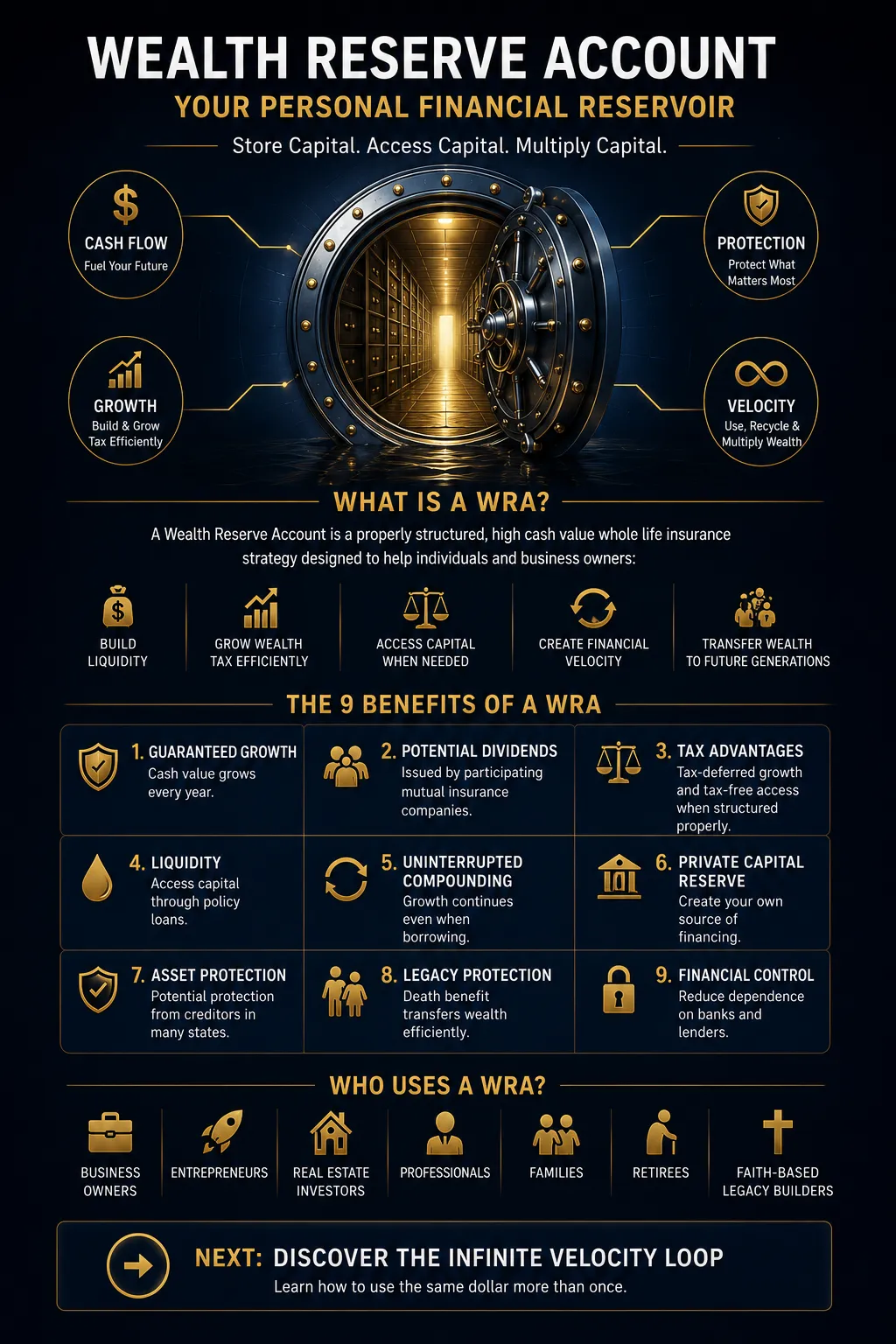

What Is a Wealth Reserve Account (WRA)? A Better Place to Store, Access, Grow, and Control Your Money
Have you ever wondered:
"There has to be a better place to store my money than a traditional checking or savings account."
Even when a traditional savings account pays interest, that account may primarily serve one purpose: storing your money.
And depending on your circumstances, the interest you earn may also create taxable income.
So the bigger question becomes:
Is there another place where I can store my capital while maintaining access, control, protection, growth potential, and long-term legacy benefits?
That's where the Wealth Reserve Account, or WRA, comes into the conversation.
Not your IRA. Not your 401(k). Your WRA.
What Is a Wealth Reserve Account?
A Wealth Reserve Account (WRA) is a wealth-building strategy that uses a specially designed whole life insurance policy, typically structured with a dividend-paying mutual insurance company and designed with an emphasis on cash value accumulation.
The objective is to create a personal financial reserve that can provide a combination of:
- Long-term cash value growth
- Access to capital
- Permanent life insurance protection
- Tax advantages under current tax law
- Financial flexibility
- Legacy and wealth-transfer benefits
Rather than thinking about the WRA as simply another savings account, think of it as a personal financial reservoir.
It is designed to help you:
Protect. Grow. Preserve. Transfer.
More Than Just a Place to Store Money
Traditional accounts may provide a place to store cash.
A properly designed Wealth Reserve Account is intended to do more than simply hold money.
It can potentially become part of a larger financial system designed to:
- Store capital
- Access capital
- Protect capital
- Grow capital
- Leverage capital
- Transfer wealth
- Create financial velocity
Your WRA Can Become Your Personal Reservoir
Your cash flow enters your financial reservoir.
Your reserves can grow inside the policy.
You can potentially access capital through policy loans.
And you can redeploy capital for other financial needs and opportunities while the policy continues operating according to its contractual terms.
What Does a Wealth Reserve Account Help You Do?
Build Wealth
A properly designed whole life insurance policy can accumulate contractual cash value over time.
Keep More
Life insurance receives unique treatment under the Internal Revenue Code, and properly structured policies may provide tax advantages when designed and managed correctly.
Leave a Legacy
Life insurance can provide a death benefit to beneficiaries and can play an important role in legacy planning, estate planning, and generational wealth transfer.
Maintain Access
As cash value develops, it may be accessed through withdrawals or policy loans according to the provisions of the policy.
Maintain Control
The policy owner maintains contractual rights and control over how policy values are used, subject to the terms of the insurance contract.
Who Is the Wealth Reserve Account For?
A Wealth Reserve Account may be worth exploring for individuals, families, and organizations looking for greater financial flexibility and a long-term wealth strategy.
Families and Parents
Parents who want to:
- Protect their families
- Provide financial security
- Build reserves
- Create a lasting legacy
- Transfer wealth to future generations
Business Owners and Entrepreneurs
Business owners who are looking for:
- Additional liquidity
- Access to private capital reserves
- Business continuity planning
- Tax-efficient strategies
- Key-person or business protection
- Long-term financial flexibility
Professionals and High Earners
Professionals who want:
- Greater control over their money
- Additional tax-efficient planning options
- Asset diversification
- Long-term cash accumulation
- Greater financial flexibility
Pre-Retirees and Retirees
Individuals approaching retirement who want to explore:
- Tax-advantaged access to policy values
- Additional retirement liquidity
- Legacy protection
- Death benefit protection
- Another potential source of retirement cash flow
Institutions, Organizations, and Entities
Businesses and organizations may also use permanent life insurance as part of certain long-term financial, benefit, succession, or capital-reserve strategies.
Key Wealth Reserve Account Benefits
1. Tax-Advantaged Cash Value Growth
Cash value inside a properly structured whole life insurance policy generally grows on a tax-deferred basis.
This means you generally are not paying annual income taxes simply because the policy's cash value increased during the year.
2. Tax-Advantaged Access to Your Money
Policy owners may be able to access policy values through withdrawals and policy loans.
Properly managed policy loans are generally not treated as taxable income while the policy remains in force and does not become a modified endowment contract or lapse with a taxable gain.
3. Lifetime Access
As sufficient cash value develops, you can potentially access capital for a wide variety of purposes.
Depending on your financial strategy, that might include:
- Emergencies
- Business opportunities
- Real estate
- Debt restructuring
- Education
- Major purchases
- Retirement needs
- Investment opportunities
4. Legacy Planning
Permanent life insurance creates a death benefit designed to provide money to your beneficiaries when you die.
Life insurance death benefits are generally received income-tax-free by beneficiaries under current federal tax law, subject to applicable rules and exceptions.
5. Privacy and Control
A life insurance policy is a private contract between the policy owner and the insurance company.
The policy owner generally controls how cash value is accessed and how policy proceeds are structured, subject to the terms of the contract.
How Do Policy Loans Work?
One of the most important features of a Wealth Reserve Account strategy is the ability to access cash value through a policy loan.
When you take a policy loan, you are generally borrowing from the insurance company with the policy's cash value serving as collateral.
This is different from simply withdrawing your cash value.
The loan itself accrues interest according to the insurance company's policy-loan provisions.
Do You Have to Pay Back a Policy Loan?
Policy loans generally do not have the same repayment structure as a traditional bank loan.
Depending on the policy, there may be:
- No traditional monthly loan-payment schedule
- No conventional loan maturity date
- No traditional minimum monthly payment requirement
However, this does not mean policy loans are free or that repayment does not matter.
Outstanding policy loans accrue interest and reduce the policy's available cash value and death benefit.
If an outstanding loan remains when the insured dies, the insurance company generally deducts the outstanding loan balance and accrued interest from the death benefit before paying the beneficiaries.
The flexibility of a policy loan gives you control over repayment, but responsible loan management remains important.
Why Repay Your Policy Loans?
Even when a policy does not require a conventional monthly loan payment, voluntarily repaying policy loans can be an important part of the strategy.
Repayment helps:
- Restore available borrowing capacity
- Reduce accumulated loan interest
- Protect the policy's death benefit
- Maintain financial flexibility
- Allow the same reserve to potentially be accessed again later
This is the concept behind becoming a better steward or "banker" of your own capital.
You access capital when you need it, then intentionally replenish your financial reserve so that it remains available for future opportunities.
What Is Uninterrupted Compounding?
One of the concepts frequently discussed in high-cash-value whole life strategies is uninterrupted compounding.
Because policy loans are generally loans from the insurance company secured by the policy's value, taking a policy loan is not necessarily the same as withdrawing the underlying cash value from the policy.
Depending on the policy design and insurance carrier, policy values can continue earning contractual guarantees and potentially dividends according to the policy's terms while a loan is outstanding.
Loan interest, dividend treatment, and credited values vary by insurance company and policy, so the specific contract should always be reviewed.
What Does "Financial Velocity" Mean?
One of the central ideas behind the WRA strategy is financial velocity.
Financial velocity means thinking beyond using one dollar for only one financial purpose.
The objective is to strategically recycle capital.
STORE → ACCESS → DEPLOY → REPAY → REUSE
You first build reserves.
You access capital when appropriate.
You deploy that capital toward another financial purpose.
You replenish your reserve.
Then that capital may become available for another use in the future.
This is what we mean when we talk about creating velocity with your money.
Your Cash Flow Fuels Your Future
Your Wealth Reserve Account does not operate in isolation.
The strategy begins with your cash flow.
The more effectively you manage your income, expenses, debts, and discretionary cash flow, the more effectively you may be able to fund long-term financial assets.
Your cash flow fuels your future.
The goal is to redirect part of your cash flow toward building an asset that provides protection, reserves, access, flexibility, and legacy.
9 Key Benefits of a Wealth Reserve Account
1. Guaranteed Growth
Whole life insurance includes contractual guaranteed cash values when the policy is funded according to its terms.
2. Potential Dividends
Participating whole life policies issued by mutual insurance companies may receive dividends.
Dividends are not guaranteed.
3. Tax Advantages
Properly structured life insurance can receive favorable tax treatment, including tax-deferred cash-value growth and potentially tax-advantaged access through policy loans.
4. Liquidity
Once sufficient cash value exists, policy owners can potentially access that value according to the terms of the contract.
5. Uninterrupted Compounding
Policy values may continue operating according to contractual provisions while cash value serves as collateral for a policy loan.
6. Private Capital Reserves
The cash value can become a personal reserve that may be accessed for emergencies, opportunities, business needs, or other financial objectives.
7. Asset Protection
Life insurance cash values and death benefits may receive creditor protections under certain state laws.
The level of protection varies by state and individual circumstances.
8. Legacy Protection
Permanent life insurance can create an immediate and potentially growing death benefit designed to transfer wealth to beneficiaries.
9. Financial Control
You maintain ownership rights over your policy and determine how and when you access policy values, subject to the terms of your insurance contract.
The WRA as an Emergency Fund
One potential use of a Wealth Reserve Account is as part of your emergency reserve strategy.
Instead of having every dollar of long-term reserves sitting in a traditional bank account, some individuals may choose to build a portion of those reserves inside cash-value life insurance.
Once adequate cash value exists, that reserve may potentially be accessed when unexpected financial needs occur.
The WRA as an Opportunity Fund
Your reserve does not only have to be used when something goes wrong.
It may also become an opportunity fund.
Potential opportunities could include:
- Real estate
- Business expansion
- Equipment purchases
- Investments
- Education
- Strategic debt restructuring
- Unexpected buying opportunities
The objective is to maintain access to capital so that when an appropriate opportunity appears, you have another potential source of liquidity.
The WRA for Business Owners
For entrepreneurs and business owners, liquidity can be extremely important.
A Wealth Reserve Account may potentially create another source of private capital that can be accessed for business-related needs.
Potential uses may include:
- Working capital
- Equipment
- Expansion
- Business opportunities
- Emergency liquidity
- Key-person protection
- Succession planning
- Business continuity
The WRA for Retirement Planning
Permanent life insurance may also play a role in a broader retirement income strategy.
Properly structured policy values may potentially provide an additional source of tax-advantaged cash flow during retirement.
This does not mean a Wealth Reserve Account necessarily replaces every retirement account or investment.
Instead, it may serve as another financial asset that can complement:
- 401(k) plans
- IRAs
- Business assets
- Real estate
- Investment accounts
- Pensions
- Social Security
- Other retirement-income strategies
The WRA for Legacy and Generational Wealth
One of the most powerful features of permanent life insurance is that it is designed to eventually provide money to the next generation.
During your lifetime, you can potentially build and access cash value.
At death, the remaining death benefit can provide capital to your beneficiaries.
That makes permanent life insurance a potential bridge between:
Your Lifetime Wealth Strategy
and
Your Family's Generational Wealth Strategy
When combined with appropriate estate planning, trusts, tax planning, and family financial education, life insurance may become one component of a broader legacy strategy.
Is This a New Financial Strategy?
No.
Whole life insurance has existed for generations and has long been used by individuals, families, businesses, institutions, and wealthy families as part of broader financial and estate-planning strategies.
Permanent life insurance has historically been used alongside tools such as:
- Trusts
- Estate planning
- Business succession planning
- Tax planning
- Asset protection strategies
- Family wealth-transfer strategies
The important point is that the underlying life insurance product is not new.
What matters is how the policy is designed, funded, managed, and integrated into your overall financial plan.
How the Wealth Reserve Account Strategy Works
1. STORE CAPITAL
Direct a portion of your cash flow into a specially designed whole life insurance policy.
2. BUILD YOUR RESERVE
Allow contractual cash values and potential dividends to accumulate over time.
3. ACCESS CAPITAL
Access eligible policy value when appropriate through policy loans or other contractual provisions.
4. DEPLOY CAPITAL
Use capital for emergencies, opportunities, business, investments, retirement needs, or other financial objectives.
5. REPLENISH YOUR RESERVE
Repay policy loans strategically so your available reserve can be restored.
6. TRANSFER YOUR LEGACY
Ultimately transfer the remaining life insurance death benefit to your beneficiaries according to your policy and estate plan.
What Makes a WRA Different From a Bank Savings Account?
A traditional savings account and a Wealth Reserve Account serve very different purposes.
A savings account is generally designed primarily for:
- Cash storage
- Short-term liquidity
- FDIC-insured bank deposits within applicable limits
A Wealth Reserve Account is built around permanent life insurance and may combine:
- Life insurance protection
- Cash value accumulation
- Potential dividends
- Policy-loan access
- Long-term tax advantages
- Legacy benefits
- Private capital reserves
These are fundamentally different financial tools, so the appropriate amount to place in each depends on your liquidity needs, financial goals, time horizon, and overall strategy.
Important Wealth Reserve Account Terms to Know
Wealth Reserve Account (WRA)
A strategy using a specially designed whole life insurance policy with an emphasis on permanent protection, cash value accumulation, liquidity, and long-term financial flexibility.
Whole Life Insurance
Permanent life insurance that provides contractual death benefit protection and guaranteed cash values when properly funded according to the contract.
Dividend-Paying Mutual Insurance Company
A mutual life insurance company is owned by its eligible policyholders rather than outside shareholders. Participating policies may receive dividends when declared by the insurance company.
Dividends are not guaranteed.
Cash Value
The value accumulated inside a permanent life insurance policy that may be accessible according to the provisions of the contract.
Policy Loan
A loan from the insurance company secured by the policy's cash value.
Policy loans accrue interest and reduce available cash value and death benefits if not repaid.
Death Benefit
The amount payable to beneficiaries upon the insured's death, reduced by any applicable outstanding loans or other policy obligations.
Liquidity
The ability to access available policy values according to the terms of the insurance contract.
Uninterrupted Compounding
A strategy concept referring to policy values continuing to operate according to contractual provisions while cash value is used as collateral for a policy loan.
Financial Velocity
The concept of strategically recycling capital by storing, accessing, deploying, replenishing, and potentially reusing money over time.
Frequently Asked Questions About the Wealth Reserve Account
Is a WRA the same thing as a bank account?
No.
A Wealth Reserve Account is based on a specially designed whole life insurance policy. It is not a bank checking or savings account and is not FDIC insured.
Does the WRA grow tax-free?
Cash value generally grows on a tax-deferred basis.
Properly structured withdrawals and policy loans may provide tax-advantaged access, but tax treatment depends on how the policy is structured and managed.
Are policy loans tax-free?
Policy loans are generally not treated as taxable income while the policy remains properly structured and in force.
A policy lapse or surrender with outstanding loans can potentially create taxable consequences.
Do I have to repay policy loans?
Policy loans often provide flexible repayment terms, but unpaid loans accrue interest and reduce available policy values and the death benefit.
Strategic repayment can help preserve the long-term effectiveness of the policy.
Can I use the money for anything I want?
Generally, policy-loan proceeds are not restricted to a specific purpose.
Policy owners may potentially use available capital for business, emergencies, investments, education, major purchases, retirement, opportunities, or other personal financial needs.
Are whole life dividends guaranteed?
No.
Participating whole life insurance policies may receive dividends when declared by the insurance company, but dividends are not guaranteed.
Is there guaranteed growth?
Whole life insurance contracts typically include guaranteed cash values and guaranteed death benefit provisions, assuming the policy is properly funded and contractual requirements are satisfied.
Can a WRA replace my IRA or 401(k)?
Not necessarily.
A Wealth Reserve Account is a different financial tool and may be used alongside retirement accounts, investments, real estate, business assets, and other financial strategies.
Can I use a Wealth Reserve Account for retirement?
Potentially.
Cash value life insurance may become one component of a diversified retirement strategy and may provide another potential source of liquidity or tax-advantaged cash flow.
Can I leave the WRA to my family?
The policy's death benefit is designed to transfer money to the named beneficiaries at death, subject to the terms of the policy.
The Bigger Financial Strategy
A Wealth Reserve Account is not simply about buying life insurance.
The bigger objective is to create a financial system that gives your money multiple responsibilities.
Protect your family.
Build your reserves.
Maintain access to capital.
Create financial velocity.
Grow wealth efficiently.
Preserve what you build.
Transfer a legacy.
Instead of asking only:
"Where can I get the highest interest rate?"
A different question may be:
"Where can I position my money so that it can perform multiple financial functions while I maintain greater access and control?"
That is the bigger idea behind the Wealth Reserve Account.
The Wealth Reserve Account Formula
PROTECT → STORE → GROW → ACCESS → DEPLOY → REPLENISH → TRANSFER
Protect your family and future income.
Store a portion of your capital in a permanent asset.
Grow contractual cash value over time.
Access available capital when appropriate.
Deploy capital toward opportunities and financial needs.
Replenish the reserve by strategically repaying loans.
Transfer wealth through the policy's death benefit.
The Bottom Line
Your Wealth Reserve Account is designed to become more than simply another place to put money.
It can potentially become a foundational financial reserve designed around:
- Protection
- Growth
- Liquidity
- Control
- Tax efficiency
- Financial velocity
- Legacy
The goal is not simply to accumulate money.
The goal is to build a financial system that allows you to build wealth, keep more, maintain access and control, and leave a lasting legacy.
What Would a Wealth Reserve Account Look Like for You?
Every Wealth Reserve Account should be designed around the individual.
Your appropriate policy design may depend on factors such as:
- Your age
- Your health
- Your income
- Your cash flow
- Your desired death benefit
- Your savings capacity
- Your business needs
- Your retirement goals
- Your legacy goals
Schedule Your Wealth Reserve Design & Review
If you would like to see what a properly designed Wealth Reserve Account could look like for you, request a personalized illustration and strategy review.
Visit WealthReserveAccount.com to learn more and schedule your Wealth Reserve Design & Review.
Topics Covered in This Video
Wealth Reserve Account, WRA, whole life insurance, high cash value whole life insurance, dividend-paying mutual insurance company, cash value life insurance, tax-advantaged wealth building, tax-deferred cash value growth, tax-advantaged income, policy loans, life insurance policy loans, policy loan repayment, uninterrupted compounding, financial velocity, private capital reserves, personal banking strategy, banking with whole life insurance, family banking strategy, personal reservoir, emergency fund, opportunity fund, liquidity, financial control, guaranteed cash value, whole life dividends, paid-up additions, permanent life insurance, death benefit, tax-free death benefit, legacy planning, generational wealth, estate planning, asset protection, retirement planning, retirement income, business planning, business capital, business continuity, high earners, entrepreneurs, families, professionals, pre-retirees, retirees, wealth preservation, wealth transfer, cash flow, financial freedom, retirement liquidity, private banking strategy, wealth building, protect grow preserve transfer, store capital, access capital, multiply capital, and financial efficiency.