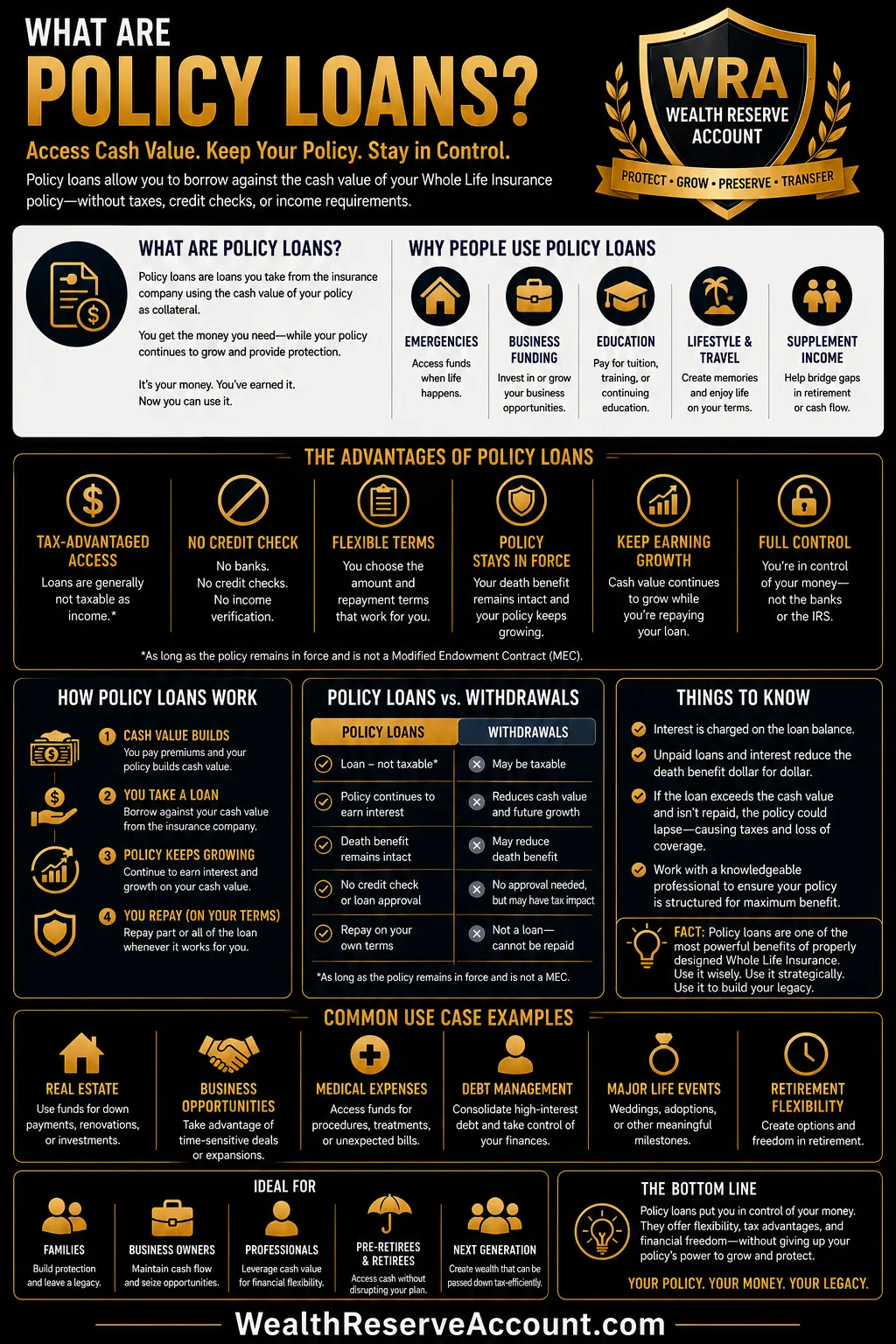

How Do Policy Loans Work in a Wealth Reserve Account?
How do policy loans work inside a Wealth Reserve Account, or WRA?
Do you have to apply and get approved?
Does borrowing against your life insurance affect your credit?
Do you have to prove your income?
And what happens to your cash value and death benefit while you have an outstanding policy loan?
These are important questions because policy-loan access is one of the key features of a properly designed high-cash-value whole life insurance policy.
Policy loans allow you to access capital by borrowing against the cash value of your whole life insurance policy, without going through traditional bank lending or conventional credit underwriting.
What Is a Wealth Reserve Account?
A Wealth Reserve Account (WRA) is a specially designed whole life insurance strategy, typically structured with a dividend-paying mutual insurance company and designed with an emphasis on maximizing cash value within the policy's design parameters.
The objective is to create a financial reservoir where you can potentially:
- Store capital
- Build contractual cash value
- Receive potential dividends
- Maintain permanent life insurance protection
- Create an emergency reserve
- Create an opportunity fund
- Access available capital
- Deploy capital toward financial opportunities
- Build long-term wealth
- Create a legacy for future generations
One of the primary ways you can access that accumulated value is through a whole life insurance policy loan.
What Is a Policy Loan?
A policy loan is a loan made by the life insurance company using the available cash value of your policy as collateral.
You are not applying for an unsecured personal loan.
You are borrowing against an asset that already exists inside your life insurance contract.
Because the insurance company has policy value securing the loan, the process is fundamentally different from conventional bank financing.
CASH VALUE → COLLATERAL → POLICY LOAN → ACCESS TO CAPITAL
Your policy's cash value supports the loan, while the death benefit ultimately provides additional protection to the insurance company against an outstanding balance.
Do Policy Loans Require a Credit Check?
Generally, no.
A policy loan typically does not require the traditional credit underwriting associated with a bank loan, credit card, or personal loan.
That generally means:
- No traditional credit check
- No minimum FICO score
- No conventional loan underwriting
- No traditional debt-to-income calculation
- No conventional income qualification
The primary consideration is whether your policy has sufficient available cash value to support the requested loan.
Do Policy Loans Affect Your Credit?
Policy loans generally are not structured or reported like conventional consumer debt.
Because you are borrowing from the insurance company against the value of your policy rather than obtaining a traditional unsecured loan, policy loans generally do not involve the conventional credit-reporting process associated with credit cards, personal loans, or bank financing.
Your available cash value—not your credit score—is generally what determines how much you can borrow.
Do You Have to Prove Your Income?
Generally, policy-loan access does not require conventional income verification.
Once your policy is established and sufficient cash value is available, you are accessing a contractual feature of an asset you already own.
You typically are not required to qualify based on:
- Salary
- Employment status
- Business revenue
- Debt-to-income ratio
- Traditional lending criteria
How Do Policy Loans Work?
The process can be understood in four basic steps.
Step 1: Fund Your Policy
You pay premiums into your properly designed whole life insurance policy.
As the policy develops, it builds contractual cash value.
A participating whole life policy may also receive dividends when declared by the insurance company.
Step 2: Build Available Cash Value
As cash value accumulates, a portion may become available to support policy loans.
Your available loan amount depends on the policy's cash value, existing loans, carrier rules, and the terms of your contract.
Step 3: Borrow Against Your Cash Value
You request a policy loan from the insurance company.
The insurance company lends you money using your available policy value as collateral.
You can then deploy that capital according to your financial needs and objectives.
Step 4: Repay the Policy Loan
Policy loans generally provide more repayment flexibility than conventional consumer loans.
Depending on your contract, you may choose to repay part or all of the loan according to your financial strategy.
Repaying the loan reduces the outstanding balance and restores available borrowing capacity.
The Policy Loan Cycle
FUND → BUILD CASH VALUE → BORROW → DEPLOY → REPAY → REPLENISH → REUSE
This is one of the concepts behind creating financial velocity with a Wealth Reserve Account.
Instead of viewing accumulated capital as money that must remain untouched, the objective is to build a reserve that may potentially be accessed and strategically reused throughout your lifetime.
What Are the Advantages of Policy Loans?
1. No Traditional Credit Check
Policy loans generally do not require conventional credit underwriting because the policy's cash value serves as collateral.
2. No Traditional Income Verification
Your employment income or business revenue generally does not determine whether you qualify for an available policy loan.
3. Flexible Repayment
Policy loans typically offer flexible repayment provisions compared with conventional amortizing loans.
You can generally choose when and how much to repay, subject to the terms of your insurance contract.
4. Potential Tax Advantages
Policy-loan proceeds generally are not treated as taxable income while the policy remains properly structured and in force.
Tax consequences can arise in certain circumstances, including policy lapse or surrender with a taxable gain or when the policy is classified as a Modified Endowment Contract.
5. Continued Policy Value
A policy loan generally uses cash value as collateral rather than directly withdrawing that underlying value from the contract.
The policy continues operating according to its contractual terms while the loan is outstanding.
6. Control Over How the Money Is Used
Policy-loan proceeds generally are not restricted to one particular use.
This can provide significant flexibility when emergencies, opportunities, or major financial needs arise.
Does Your Cash Value Keep Growing When You Take a Policy Loan?
This is one of the most important concepts to understand about whole life insurance policy loans.
When you take a policy loan, you generally are not withdrawing the underlying cash value securing the loan.
Instead, the insurance company is lending you money while using policy value as collateral.
The policy continues operating according to the terms of the contract.
However, the exact effect of an outstanding loan on dividends, credited values, and future policy performance depends on the insurance company, policy design, loan provisions, and whether the carrier uses direct or non-direct recognition.
A policy loan can give you access to capital without requiring you to directly remove the underlying cash value securing that loan.
What Is Uninterrupted Compounding?
The concept of uninterrupted compounding refers to maintaining policy value inside the insurance contract while using that value as collateral to access capital elsewhere.
Instead of withdrawing the cash value and permanently removing those dollars from the policy, a policy loan allows you to access capital against the value.
CASH VALUE REMAINS IN POLICY → CAPITAL IS BORROWED → CAPITAL IS DEPLOYED
This concept is central to strategies such as the Wealth Reserve Account, Infinite Banking, and Infinite Velocity.
Policy Loan vs. Withdrawal: What's the Difference?
There are two common ways to access value from a permanent life insurance policy:
- Policy loans
- Withdrawals
They are not the same.
| Feature | Policy Loan | Withdrawal |
|---|---|---|
| How You Access Money | Borrow against available policy value | Remove value directly from the policy |
| Credit Check | Generally no conventional credit check | No credit check |
| Income Verification | Generally not required | Not required |
| Repayment | Can generally be repaid | Not a loan and generally cannot simply be repaid as a loan |
| Loan Interest | Interest is charged on outstanding loan balance | No loan interest because it is not a loan |
| Cash Value | Uses policy value as collateral | Directly reduces policy value |
| Death Benefit | Outstanding loans and interest can reduce the net death benefit | May permanently reduce the death benefit |
| Tax Treatment | Generally not taxable when properly structured and managed | May be taxable depending on basis, policy status, and circumstances |
Are Withdrawals From Whole Life Insurance Always Taxable?
No.
This is an important distinction.
A withdrawal from a non-MEC life insurance policy is not automatically taxable. Tax treatment depends on factors such as your cost basis, the amount withdrawn, and the status of the policy.
Generally, distributions from a non-MEC policy may receive first-in, first-out (FIFO) tax treatment, meaning amounts may potentially be received up to the policy owner's basis before taxable gain is recognized.
However, withdrawals directly reduce policy value and may also reduce the death benefit.
This is one reason policy loans are often preferred when the objective is to maintain policy value while accessing capital.
What Happens If Your Policy Is a MEC?
A Modified Endowment Contract (MEC) receives different tax treatment from a non-MEC life insurance policy.
Distributions, including loans, from a MEC may be taxable to the extent of gain and may also be subject to an additional 10% federal tax penalty when applicable before age 59½.
For someone building a Wealth Reserve Account with the goal of flexible policy-loan access, avoiding unintended MEC status can therefore be an important part of the policy design.
Policy design matters. How the policy is funded can affect how distributions and policy loans are treated for tax purposes.
Do You Have to Repay a Policy Loan?
Policy loans generally do not have to be repaid according to the same fixed monthly schedule as a conventional bank loan.
However, that does not mean repayment should be ignored.
Policy-loan interest continues to accrue.
An outstanding loan reduces the amount of net death benefit ultimately available to beneficiaries.
Repaying a policy loan can:
- Reduce the outstanding loan balance
- Reduce future loan-interest costs
- Restore available borrowing capacity
- Protect the net death benefit
- Allow you to potentially reuse the capital again
Flexible repayment gives you control—but responsible repayment helps preserve the power of the system.
What Happens to a Policy Loan When You Die?
If a policy loan remains outstanding when the insured dies, the insurance company generally deducts the outstanding loan balance and accrued interest from the death benefit.
The remaining net death benefit is then paid to the beneficiary according to the policy terms.
DEATH BENEFIT − OUTSTANDING LOAN − ACCRUED INTEREST = NET DEATH BENEFIT
This is why an outstanding policy loan should always be considered as part of your overall legacy and policy-management strategy.
What Happens If You Borrow Too Much?
Important: Policy Loans Must Be Managed
Policy loans are powerful financial tools, but excessive borrowing can create significant risks.
Interest is charged on outstanding policy loans.
If the outstanding loan balance and accumulated interest become too large relative to the policy's available value, the policy may be at risk of lapsing.
If a policy with a taxable gain lapses or is surrendered while a significant loan is outstanding, a taxable event may occur even though the policy owner does not receive additional cash at that time.
A lapse also terminates the life insurance coverage.
This is why ongoing policy monitoring and responsible loan management are important.
What Can You Use a Policy Loan For?
Policy-loan proceeds generally are not restricted to a particular purpose.
That gives the policy owner significant flexibility.
Emergency Expenses
A WRA can potentially serve as part of your emergency reserve.
Policy-loan proceeds may help provide liquidity for unexpected expenses without requiring you to rely entirely on credit cards or outside financing.
Real Estate Investing
Available policy value may potentially provide capital for:
- Down payments
- Renovations
- Repairs
- Closing costs
- Investment opportunities
Borrowing to invest introduces leverage and risk, so the expected return, policy-loan cost, liquidity, and repayment strategy should be evaluated carefully.
Business Funding
Business owners may potentially use policy-loan proceeds for:
- Working capital
- Inventory
- Equipment
- Marketing
- Expansion
- Hiring
- Business opportunities
Education
Policy-loan proceeds may potentially be used for:
- College tuition
- Housing
- Books
- Trade school
- Graduate school
- Other education expenses
Medical Expenses
Available capital may potentially be used for procedures, treatments, deductibles, or unexpected medical bills.
Debt Management
Policy-loan proceeds may potentially be used to consolidate or eliminate higher-cost debt.
The goal should not simply be to move debt.
The objective should be to improve cash flow and create a strategy for repaying and replenishing the policy loan.
Major Life Events
Policy-loan proceeds may potentially be used for:
- Weddings
- Adoptions
- Travel
- Major purchases
- Family milestones
Retirement Flexibility
A seasoned whole life policy may potentially provide another source of liquidity during retirement.
Policy loans may potentially supplement other retirement income sources when structured and managed appropriately.
Who Can Benefit From a Wealth Reserve Account?
A properly designed WRA may potentially be useful for:
- Families
- Parents
- Business owners
- Entrepreneurs
- Professionals
- High-income earners
- Real estate investors
- Pre-retirees
- Retirees
- Families planning for the next generation
The appropriate design depends on your financial goals, cash flow, protection needs, age, health, and ability to qualify for life insurance.
Policy Loans and Financial Velocity
Policy loans can become part of a larger financial strategy when borrowed capital is deployed intentionally.
For example:
BUILD CASH VALUE → BORROW → DEPLOY → CREATE CASH FLOW → REPAY → REUSE
Borrowed capital might be used to eliminate expensive debt, acquire an asset, fund a business, purchase real estate, or take advantage of another opportunity.
If that deployment improves cash flow, creates profits, generates returns, or reduces expenses, a portion of the resulting cash flow can potentially be used to repay the policy loan.
Repayment restores borrowing capacity, allowing the cycle to potentially be repeated.
Policy Loans and Infinite Velocity
This process is part of what I call the Infinite Velocity Loop.
EARN → STORE → BUILD → BORROW → DEPLOY → GENERATE → REPAY → RECYCLE
The goal is not simply to accumulate money and never use it.
The goal is to create a financial system where your accumulated capital can potentially help solve financial problems and create opportunities while maintaining long-term protection and reserves.
Policy Loans vs. Traditional Bank Loans
| Feature | Policy Loan | Traditional Bank Loan |
|---|---|---|
| Credit Check | Generally not required | Usually required |
| Income Verification | Generally not required | Often required |
| Collateral | Life insurance policy value | Varies by loan |
| Use of Funds | Generally unrestricted | May be restricted depending on loan |
| Repayment | Generally flexible under policy terms | Usually fixed by lender agreement |
| Traditional Approval Process | Generally based on available policy value | Based on lender underwriting |
Frequently Asked Questions About Policy Loans
What is a whole life insurance policy loan?
A policy loan is money borrowed from the insurance company using available policy cash value as collateral.
Do I have to apply for a policy loan?
You generally request the loan from the insurance company, but it typically does not involve conventional credit underwriting or the same approval process used for a bank loan.
Does a policy loan require a credit check?
Generally, no.
Available policy value rather than conventional creditworthiness generally supports the loan.
Does a policy loan affect my credit score?
Policy loans generally are not handled like conventional consumer credit and typically do not involve traditional credit reporting.
Do I need to verify my income?
Conventional income verification generally is not required for a policy loan.
Are policy loans tax-free?
Policy-loan proceeds generally are not treated as taxable income while a non-MEC policy remains properly structured and in force.
Tax consequences can arise under certain circumstances, particularly if a policy with gain lapses or is surrendered with an outstanding loan.
Are policy loans from a MEC taxable?
MEC distributions, including loans, receive different tax treatment and may be taxable to the extent of gain.
Do policy loans charge interest?
Yes.
The insurance company charges interest on the outstanding policy-loan balance.
Do I have to make monthly payments?
Policy loans generally do not use the same fixed monthly amortization schedule as conventional bank loans, although loan interest continues to accrue.
Can I pay my policy loan back early?
Generally, yes.
Policy owners can typically make partial or full repayments subject to the policy's provisions.
Can I choose what I use the money for?
Generally, yes.
Policy-loan proceeds typically are not restricted to a specific use.
Can I use a policy loan to pay off debt?
Yes, available policy-loan proceeds may potentially be used to consolidate or eliminate debt.
Can I use a policy loan to buy real estate?
Policy-loan proceeds may potentially be used for real estate, down payments, renovations, or other investment-related expenses.
Can I use a policy loan for my business?
Available policy-loan proceeds may potentially provide capital for business expenses or opportunities.
Does my policy keep growing while I have a loan?
The policy continues operating according to its contractual terms. The specific impact of the loan on policy values and dividends depends on the carrier and contract.
Does a policy loan reduce my death benefit?
An outstanding loan and accrued interest generally reduce the net death benefit that would ultimately be paid to beneficiaries.
What happens if I never repay my policy loan?
If the policy remains in force until death, the outstanding loan and accrued interest generally are deducted from the death benefit.
However, excessive borrowing can put the policy at risk of lapse, which may create tax consequences and terminate coverage.
Important Policy Loan Risks to Understand
Policy loans can provide significant flexibility, but they should be used strategically.
Before borrowing, understand that:
- Policy loans charge interest
- Interest can compound if unpaid
- Outstanding loans reduce the net death benefit
- Loans reduce available borrowing capacity
- Excessive borrowing can increase lapse risk
- A policy lapse with a taxable gain may create a tax liability
- MEC policies receive different tax treatment
- Dividend treatment may vary when loans are outstanding
- Policy design and carrier provisions matter
Policy loans are powerful when used wisely, strategically, and as part of a properly managed financial plan.
The Bigger Strategy
The real benefit of a policy loan is not simply that you can borrow money.
It is that you can build an asset first and then potentially use that asset as collateral to access capital.
Build your reserve.
Maintain protection.
Create liquidity.
Access capital.
Deploy capital strategically.
Repay and replenish.
Reuse your capital.
Build your legacy.
This is one of the reasons policy loans can become such an important component of a properly designed Wealth Reserve Account.
The Bottom Line
Policy loans can put you in greater control of how you access and deploy the capital accumulated inside your Wealth Reserve Account.
They can potentially provide:
- No traditional credit check
- No conventional income verification
- Flexible repayment
- Potential tax advantages
- Access to capital
- Liquidity
- Freedom in how proceeds are used
- The ability to use policy value as collateral
- A strategy for creating financial velocity
But policy loans are still loans.
They charge interest, affect the net death benefit while outstanding, and must be managed carefully to prevent excessive leverage or policy lapse.
Use policy loans wisely. Use them strategically. Use them to create opportunities, improve financial efficiency, and help build your legacy.
What Would a Wealth Reserve Account Look Like for You?
A properly designed Wealth Reserve Account should be based on your individual financial circumstances, protection needs, cash flow, objectives, age, health, and ability to qualify.
Your personalized WRA design may consider:
- Your desired death benefit
- Your available cash flow
- Your emergency-fund goals
- Your opportunity-fund goals
- Your desired cash-value accumulation
- Your business needs
- Your debt strategy
- Your retirement goals
- Your legacy goals
Schedule Your Wealth Reserve Design & Review
If you would like to see an illustration showing how a properly designed high-cash-value whole life insurance policy could potentially work for you, schedule a Wealth Reserve Design & Review.
Visit WealthReserveAccount.com to learn more and schedule your appointment.
Protect Capital. Access Capital. Create Financial Velocity. Build Tax-Efficient Wealth. Leave a Legacy.
Topics Covered in This Video
Wealth Reserve Account, WRA, policy loans, life insurance policy loans, whole life insurance policy loans, how policy loans work, how do life insurance policy loans work, borrowing against life insurance, borrowing against whole life insurance, borrowing against cash value, cash value loans, cash value life insurance, whole life insurance, high cash value whole life insurance, dividend-paying whole life insurance, dividend-paying mutual insurance company, whole life cash value, guaranteed cash value, whole life dividends, paid-up additions, policy loan interest, policy loan repayment, policy loan rates, policy loan tax treatment, tax-free policy loans, tax-advantaged policy loans, are policy loans taxable, life insurance loans and taxes, policy loans without credit check, life insurance loan without credit check, policy loans and credit score, life insurance loan without income verification, policy loan approval, policy loans vs withdrawals, life insurance withdrawals, whole life withdrawals, FIFO life insurance, life insurance cost basis, Modified Endowment Contract, MEC, MEC policy loans, MEC taxation, non-MEC life insurance, uninterrupted compounding, uninterrupted growth, direct recognition, non-direct recognition, policy loan collateral, death benefit, policy loans and death benefit, policy lapse, life insurance lapse taxes, emergency fund, opportunity fund, private capital reserves, business funding, business capital, real estate investing, real estate down payment, education funding, college funding, medical expenses, debt consolidation, debt management, debt elimination, Debt-to-Wealth Transfer, weddings, adoption expenses, travel funding, major purchases, retirement income, tax-advantaged retirement income, retirement planning, financial velocity, Infinite Velocity, Infinite Velocity Loop, Infinite Banking, personal banking strategy, family banking system, financial control, financial flexibility, liquidity, leverage cash value, leverage life insurance, store capital, access capital, deploy capital, repay capital, recycle capital, wealth building, life insurance wealth building, tax-efficient wealth, permanent life insurance, generational wealth, legacy planning, family legacy, protect capital, access capital, build wealth, and leave a legacy.