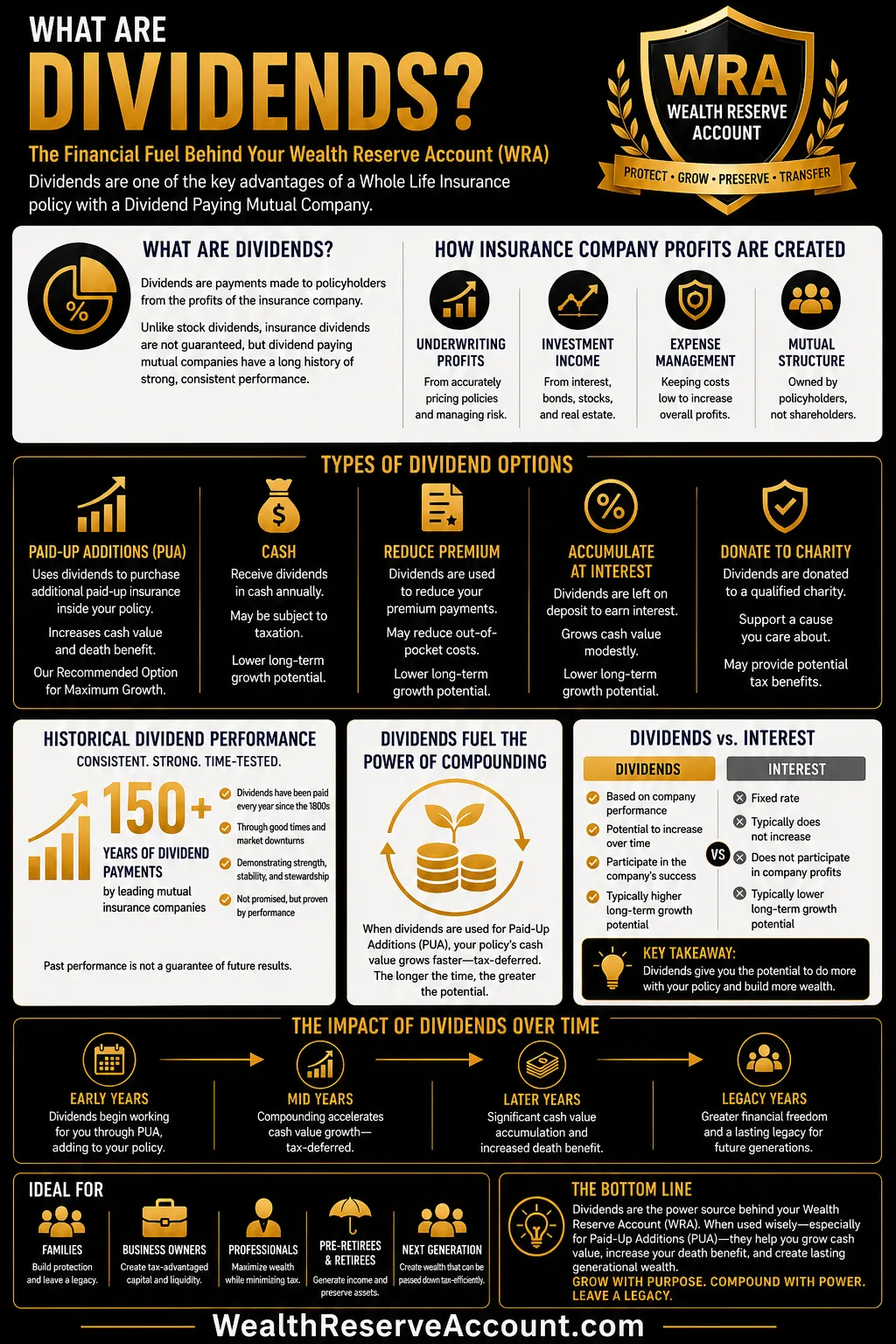

What Are Whole Life Insurance Dividends? How Dividends Can Help Grow Your Wealth Reserve Account
What are life insurance dividends, and how do they work?
If you own a participating whole life insurance policy with a dividend-paying mutual insurance company, dividends can become an important part of how your policy builds value over time.
Inside a properly designed Wealth Reserve Account, or WRA, dividends may be used to increase cash value, purchase additional paid-up insurance, grow the death benefit, and support long-term compounding.
Dividends can become one of the financial engines behind a properly designed Wealth Reserve Account.
What Is a Wealth Reserve Account?
A Wealth Reserve Account (WRA) is a whole life insurance strategy typically built with a dividend-paying mutual insurance company and designed with an emphasis on high cash value.
The policy may provide:
- Permanent life insurance protection
- Guaranteed contractual cash value
- Potential dividends
- Paid-up additions
- Policy-loan access
- Liquidity
- Tax-deferred cash-value growth
- Legacy and wealth-transfer benefits
Dividends are one of the non-guaranteed components that may enhance the long-term performance of a participating whole life policy.
What Are Whole Life Insurance Dividends?
Whole life insurance dividends are distributions that may be paid to participating policyholders when declared by the insurance company.
They are associated with the financial performance of the mutual insurance company.
Unlike contractual guarantees inside the policy:
Dividends are not guaranteed.
However, many established mutual life insurance companies have long histories of paying dividends to eligible participating policyholders.
Why Does a Mutual Insurance Company Pay Dividends?
Mutual insurance companies do not operate with outside shareholders in the same way publicly traded stock companies do.
Eligible participating policyholders have an ownership interest in the mutual company structure.
When financial results permit, the company may declare dividends to participating policyholders.
MUTUAL COMPANY PERFORMANCE → DIVIDEND DECLARATION → POLICYHOLDER BENEFIT
Where Do Life Insurance Dividends Come From?
Dividends can be influenced by several aspects of an insurance company's financial performance.
1. Underwriting Experience
Insurance companies price policies based on assumptions about mortality, claims, and risk.
When actual experience is more favorable than the assumptions used in pricing, that can contribute to overall company performance.
2. Investment Income
Life insurance companies maintain large general accounts and invest company assets according to regulatory and investment guidelines.
Those portfolios may include assets such as:
- Bonds
- Mortgages
- Real estate
- Other permitted investments
The policyholder is not directly investing the policy cash value in these assets. Rather, investment performance of the insurer's general account can influence the company's overall financial results.
3. Expense Management
Efficiently managing operating expenses can also contribute to favorable financial results.
4. Mutual Company Structure
Because a mutual insurance company is organized for the benefit of its eligible policyholders rather than outside shareholders, declared dividends may be distributed to participating policyholders.
Are Whole Life Insurance Dividends Guaranteed?
No.
This distinction is extremely important.
Whole life insurance policies may contain guaranteed contractual values, but dividends themselves are not guaranteed.
The amount of a future dividend can change based on the insurer's experience, financial performance, interest-rate environment, expenses, mortality experience, and other factors.
Guaranteed values and dividend-based values should always be viewed separately.
What Are the 5 Common Dividend Options?
When a dividend is declared, the policy owner may generally have several options for how that dividend is used.
1. Purchase Paid-Up Additions (PUAs)
One dividend option is to use dividends to purchase paid-up additions, or PUAs.
Paid-up additions are additional amounts of fully paid-up whole life insurance added to the policy.
This can increase:
- Cash value
- Death benefit
- Future dividend potential
- Long-term compounding potential
For a Wealth Reserve Account designed around long-term cash-value accumulation, using dividends to purchase paid-up additions is often an important option to consider.
Why Paid-Up Additions Can Be So Powerful
When dividends purchase additional paid-up insurance, that additional insurance can itself build cash value and potentially participate in future dividends.
DIVIDEND → PUA → MORE CASH VALUE → MORE DEATH BENEFIT → FUTURE GROWTH
Over time, this creates a compounding effect.
Instead of removing the dividend from the policy, the dividend is used to purchase additional insurance that may increase the future value of the contract.
2. Receive Dividends as Cash
Another option is to receive the declared dividend directly in cash.
This provides immediate access to the dividend.
However, once the dividend leaves the policy, it is no longer being used to purchase additional insurance or support future compounding inside the contract.
The tax treatment of cash dividends depends on the policy owner's basis and individual circumstances.
3. Use Dividends to Reduce Premiums
Dividends may also be used to offset or reduce premium payments.
This can reduce the amount of premium the policy owner must pay out of pocket.
However, using dividends to reduce premiums means those dividends are not being used to purchase additional paid-up insurance.
That can affect the policy's future cash-value and death-benefit growth compared with reinvesting the dividends.
4. Accumulate Dividends at Interest
Some policies allow dividends to remain with the insurance company and accumulate at interest.
The accumulated dividend account earns interest according to the insurer's applicable rate.
This may provide another way to retain value rather than taking the dividend immediately in cash.
However, this option functions differently from purchasing paid-up additions and may produce different long-term results.
5. Use Dividends for Charitable Giving
Depending on the carrier and planning strategy, policyholders may also coordinate dividends or other policy proceeds with charitable giving.
This may support a cause or organization that matters to you.
Any potential tax deduction or charitable tax treatment depends on how the contribution is structured and should be reviewed with a qualified tax professional.
Which Dividend Option Is Best for Maximum Long-Term Growth?
If the objective is maximizing long-term policy growth, using dividends to purchase paid-up additions is often an important strategy to evaluate.
The reason is that the dividend remains inside the policy and purchases additional fully paid-up life insurance.
That can increase both:
- Cash value
- Death benefit
The additional paid-up insurance may then participate in future dividends, subject to the insurer's dividend declaration.
Reinvesting dividends can create a compounding cycle inside the policy.
How Dividends Fuel Compounding
Compounding becomes more powerful when growth is allowed to remain inside a financial asset for long periods of time.
With a whole life policy using paid-up additions, the process may look like:
DIVIDEND → PUA → CASH VALUE → FUTURE DIVIDEND POTENTIAL → MORE PUAs
As the cycle continues, the policy may accumulate more cash value and death benefit over time.
How Are Life Insurance Dividends Taxed?
Life insurance dividends receive unique tax treatment.
In many circumstances, dividends are treated as a return of premium for federal income-tax purposes until the policy owner's cost basis has been recovered.
That means dividends are not automatically taxable simply because they are declared.
However, taxation can depend on:
- Your policy basis
- The dividend option selected
- Accumulated interest
- Withdrawals or distributions
- Policy status
- Your individual tax circumstances
Tax questions should be reviewed with a qualified tax professional.
Do Dividends Grow Tax-Free?
It is more precise to describe cash value growth inside a properly structured whole life policy as tax-deferred.
Policy owners generally do not owe annual income tax simply because policy cash value increased during the year.
Properly structured policy access may also receive favorable tax treatment.
However, tax consequences can occur in situations involving:
- Policy surrender
- Policy lapse with taxable gain
- Modified Endowment Contract status
- Taxable distributions
- Interest credited to certain dividend accounts
Dividends vs. Guaranteed Values
A properly designed whole life insurance policy may contain both guaranteed and non-guaranteed elements.
| Feature | Guaranteed Values | Dividends |
|---|---|---|
| Guaranteed? | Yes, according to policy terms | No |
| Source | Contractual policy guarantees | Declared by insurer based on company experience |
| Can Increase Cash Value? | Yes | Potentially, depending on dividend option |
| Can Increase Death Benefit? | According to policy structure | Potentially, when used to purchase paid-up additions |
Dividends vs. Interest
Dividends and interest are not the same thing.
| Feature | Whole Life Dividend | Interest |
|---|---|---|
| Source | Declared based on insurer experience and financial performance | Paid according to the terms of an interest-bearing account or contract |
| Guaranteed? | No | Depends on the account or contract |
| Participation in Company Experience | Yes, through the mutual participating structure | Generally no |
| Can Purchase More Insurance? | Yes, when used for paid-up additions | No |
| Can Increase Death Benefit? | Potentially through PUAs | Generally no |
Why Historical Dividend Performance Matters
One reason participating whole life insurance has attracted long-term policyholders is the dividend history of established mutual insurance companies.
Some mutual insurers have paid dividends to eligible participating policyholders for many generations and through a wide variety of economic environments.
This can include periods involving:
- Recessions
- Market downturns
- Interest-rate changes
- Wars
- Economic expansions
- Financial crises
Historical consistency can provide useful context when evaluating an insurer.
Past dividend performance does not guarantee future dividends.
How Dividends Can Affect Your Policy Over Time
The effect of dividends can become more visible as a properly designed policy matures.
Early Years
Dividends may begin purchasing paid-up additions and increasing policy values.
Middle Years
As additional paid-up insurance accumulates, compounding may become increasingly significant.
Cash value and death benefit may grow beyond the policy's guaranteed values if dividends continue to be declared.
Later Years
A seasoned policy may have accumulated substantial contractual cash value, paid-up additions, and a larger death benefit.
This can create additional flexibility for retirement, liquidity, opportunities, or legacy planning.
Legacy Years
The accumulated death benefit can ultimately provide a financial legacy to beneficiaries or a properly structured trust.
Dividends and Paid-Up Additions
Paid-up additions are particularly important in a high-cash-value whole life strategy.
A PUA is additional whole life insurance that is fully paid up when purchased.
It can provide:
- Additional cash value
- Additional death benefit
- Additional dividend eligibility
- Additional long-term compounding potential
DIVIDENDS BUY PUAs → PUAs INCREASE VALUE → MORE VALUE MAY SUPPORT FUTURE GROWTH
Dividends and Your Wealth Reserve Account
In a properly designed Wealth Reserve Account, dividends are not the only source of value.
The policy also contains contractual guarantees.
But dividends may potentially enhance the strategy by helping:
- Accelerate cash-value accumulation
- Purchase additional paid-up insurance
- Increase death benefit
- Create greater long-term policy value
- Increase future liquidity
- Support generational wealth planning
Why Dividend-Paying Mutual Companies Matter
The Wealth Reserve Account strategy typically focuses on participating whole life insurance issued by financially strong mutual insurers.
Factors that may be considered when evaluating an insurance company include:
- Financial strength
- Claims-paying ability
- Dividend history
- Policy guarantees
- Whole life product design
- Policy-loan provisions
- Paid-up additions options
- Company stability
A long dividend history can be informative, but it should never be treated as a guarantee of future performance.
Who Can Benefit From a Dividend-Paying Whole Life Policy?
Depending on individual circumstances, a participating whole life strategy may be worth exploring for:
- Families
- Parents
- Business owners
- Entrepreneurs
- Professionals
- High-income earners
- Pre-retirees
- Retirees
- Families focused on generational wealth
Frequently Asked Questions About Whole Life Dividends
What is a whole life insurance dividend?
A whole life dividend is a non-guaranteed distribution that may be declared by a participating mutual life insurance company and paid to eligible policyholders.
Are whole life insurance dividends guaranteed?
No.
Dividends depend on the insurance company's experience and financial performance and can change over time.
Where do whole life dividends come from?
Dividend declarations may reflect factors such as mortality experience, investment results, expenses, and the overall financial performance of the insurance company.
What can I do with my whole life dividends?
Depending on the policy and carrier, common options may include:
- Purchase paid-up additions
- Receive cash
- Reduce premium payments
- Accumulate dividends at interest
- Use them as part of other planning strategies
What are paid-up additions?
Paid-up additions are additional amounts of fully paid-up whole life insurance that increase cash value and death benefit.
Can dividends buy paid-up additions?
Yes, if that dividend option is available and selected.
Why use dividends to purchase PUAs?
Using dividends for paid-up additions can keep the dividend inside the policy, increase cash value and death benefit, and potentially increase future dividend participation.
Are life insurance dividends taxable?
Dividends are often treated as a return of premium for federal income-tax purposes until policy basis has been recovered.
Tax treatment depends on the policy and individual circumstances.
Does cash value grow tax-free?
Cash-value growth is more accurately described as tax-deferred. Policy owners generally do not pay annual income tax simply because cash value increased.
Can dividends increase my death benefit?
Potentially.
When dividends are used to purchase paid-up additions, those additions generally increase both cash value and death benefit.
Can dividends increase my cash value?
Yes, depending on the dividend option selected.
Paid-up additions are one way dividends can increase policy cash value.
Are whole life dividends the same as stock dividends?
No.
Participating life insurance dividends arise from the insurer-policyholder relationship and are treated differently from dividends paid to shareholders of publicly traded companies.
What happens if dividends decrease?
Non-guaranteed illustrated policy values may be lower than originally illustrated if future dividends are lower than assumed.
Contractual guaranteed values remain governed by the policy.
Can dividends help build generational wealth?
When reinvested through paid-up additions, dividends may help increase long-term cash value and death benefit, which can support broader legacy and generational wealth planning.
The Bigger Strategy
Dividends are not the only reason to own a properly designed whole life policy.
The foundation remains:
- Permanent life insurance protection
- Contractual guarantees
- Cash value
- Liquidity
- Financial flexibility
- Legacy protection
Dividends provide an additional non-guaranteed component that may enhance those benefits over time.
Guarantees create the foundation. Dividends may provide additional growth. Paid-up additions can help compound that growth over time.
The Dividend Growth Cycle
POLICY → DIVIDEND → PUA → MORE CASH VALUE → MORE DEATH BENEFIT → FUTURE GROWTH
Policy: Own a participating whole life insurance policy.
Dividend: The mutual insurance company may declare a dividend.
PUA: Use the dividend to purchase paid-up additions.
Cash Value: Paid-up additions increase policy cash value.
Death Benefit: Paid-up additions also increase the death benefit.
Future Growth: The additional insurance may participate in future dividends, creating a long-term compounding cycle.
The Bottom Line
Whole life insurance dividends can be an important part of a properly designed Wealth Reserve Account.
When dividends are declared, they can potentially be used to:
- Purchase paid-up additions
- Increase cash value
- Increase death benefit
- Reduce premiums
- Provide cash
- Accumulate at interest
- Support long-term legacy planning
For someone focused on long-term cash-value accumulation, using dividends to purchase paid-up additions can be a powerful option because it allows additional value to remain inside the policy and potentially compound.
Dividends are not guaranteed, but when they are declared and used strategically, they can help increase cash value, death benefit, financial flexibility, and long-term legacy potential.
What Would a Dividend-Paying Wealth Reserve Account Look Like for You?
Every Wealth Reserve Account should be designed based on your individual financial situation, protection needs, cash flow, age, health, and long-term goals.
Your personalized design may consider:
- Your desired death benefit
- Your available cash flow
- Your base premium
- Your paid-up additions strategy
- Your cash-value goals
- Your dividend option
- Your policy-loan goals
- Your retirement goals
- Your legacy goals
Schedule Your Wealth Reserve Design & Review
If you would like to see an illustration showing how a properly designed whole life insurance policy with a dividend-paying mutual company could potentially work for you, schedule a Wealth Reserve Design & Review.
Visit WealthReserveAccount.com to learn more and schedule your appointment.
Build Cash Value. Add Paid-Up Insurance. Increase Protection. Create Long-Term Wealth. Leave a Legacy.
Topics Covered in This Video
whole life insurance dividends, life insurance dividends, what are whole life dividends, how do life insurance dividends work, dividend-paying whole life insurance, dividend-paying mutual insurance company, mutual life insurance company, participating whole life insurance, Wealth Reserve Account, WRA, Wealth Reserve Account dividends, WRA dividends, whole life insurance, high cash value whole life insurance, cash value life insurance, guaranteed cash value, non-guaranteed dividends, dividend history, mutual company dividends, policyholder dividends, insurance company profits, underwriting profits, mortality experience, investment income, insurance company general account, expense management, paid-up additions, PUA, paid-up additions rider, whole life PUA, dividends purchase paid-up additions, dividend options, whole life dividend options, receive dividends as cash, dividends reduce premium, accumulate dividends at interest, charitable giving with life insurance, dividend taxation, are life insurance dividends taxable, return of premium dividends, tax-deferred cash value, tax-advantaged whole life insurance, dividend compounding, compounding cash value, whole life compounding, cash value growth, death benefit growth, increasing death benefit, reinvest dividends, reinvest life insurance dividends, dividend vs interest, whole life dividends vs interest, guaranteed vs non-guaranteed values, whole life guarantees, mutual insurance company ownership, policyholder ownership, life insurance financial strength, mutual company dividend history, retirement planning, retirement income, liquidity, policy loans, financial flexibility, family wealth, generational wealth, legacy planning, permanent life insurance, family banking system, Infinite Banking, life insurance wealth building, high early cash value whole life, paid-up insurance, financial velocity, cash value accumulation, wealth preservation, tax-efficient wealth, protect capital, grow capital, preserve wealth, transfer wealth, and generational legacy.