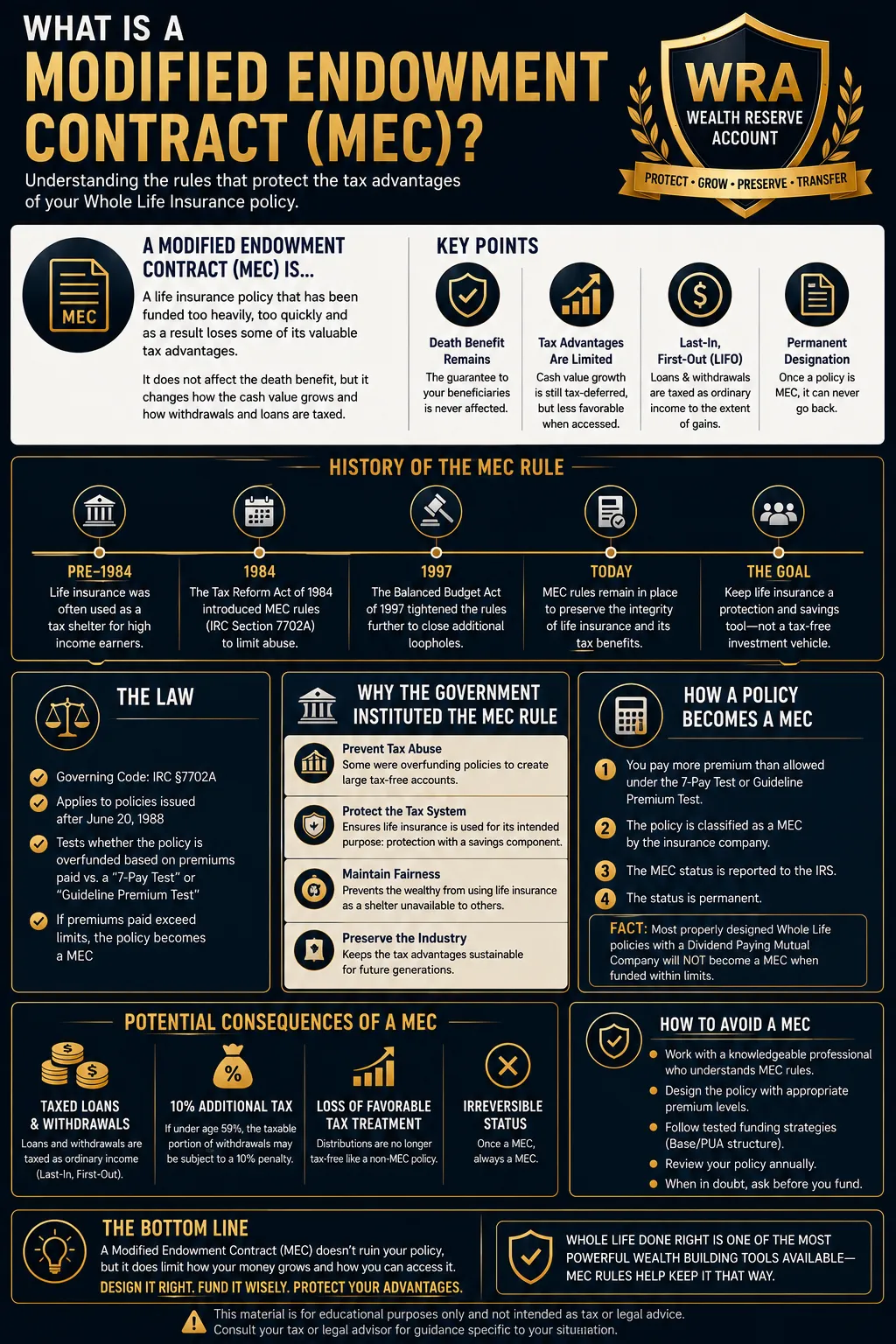

What Is a Modified Endowment Contract (MEC)? How MEC Rules Affect Whole Life Insurance and Your Wealth Reserve Account
What is a Modified Endowment Contract, or MEC?
Is it something you should be worried about?
What causes a life insurance policy to become a MEC?
And why does MEC status matter when you are designing a Wealth Reserve Account, or WRA?
These are important questions because a properly designed high-cash-value whole life insurance policy can receive significant tax advantages, but those advantages can change if the policy is classified as a Modified Endowment Contract.
A MEC does not eliminate your life insurance policy or death benefit, but it can significantly change how policy loans and withdrawals are taxed.
What Is a Modified Endowment Contract?
A Modified Endowment Contract is a life insurance policy that has been funded too heavily or too quickly under the tax rules governing permanent life insurance.
This applies to life insurance policies that build cash value, including certain whole life insurance policies.
As it relates to the Wealth Reserve Account strategy, the policy is typically a specially designed whole life insurance contract with a dividend-paying mutual insurance company.
The goal is to build significant cash value while still staying within the legal limits that preserve the policy's favorable tax treatment.
The Two Main Components of a WRA Premium
A high-cash-value whole life insurance policy is generally designed with different premium components.
In simple terms, those can include:
Base Premium
The base premium primarily supports the underlying whole life insurance contract and death benefit.
Paid-Up Additions (PUAs)
Additional premium may be directed toward paid-up additions, or PUAs, which can increase both cash value and death benefit.
The challenge is that you cannot simply put an unlimited amount of premium into a life insurance policy relative to the amount of death benefit.
There are limits.
There must be an appropriate relationship between the amount of premium going into the policy and the amount of life insurance protection supporting it.
Why Does the Government Limit How Much You Can Fund?
Permanent life insurance receives special tax treatment.
Because of those tax advantages, federal rules limit how aggressively a life insurance contract can be funded before it begins to be treated differently for tax purposes.
The life insurance company monitors the policy and determines whether it remains within the applicable MEC limits.
PREMIUM FUNDING + DEATH BENEFIT + TAX TESTING = MEC STATUS
This is one reason policy design is extremely important when building a Wealth Reserve Account for high cash value.
Why Does MEC Status Matter?
The main issue with a Modified Endowment Contract is tax treatment.
The death benefit protection can remain in place, but access to the policy's cash value becomes less tax-favorable.
The biggest change involves:
- Policy loans
- Withdrawals
- Distribution ordering
- Potential additional taxes before age 59½
MEC vs. Non-MEC Life Insurance
| Feature | Non-MEC Policy | Modified Endowment Contract |
|---|---|---|
| Death Benefit | Remains in force according to policy terms | Remains in force according to policy terms |
| Cash Value Growth | Tax-deferred | Tax-deferred |
| Policy Loans | Generally not treated as taxable income while properly structured and in force | May be taxable to the extent of gain |
| Withdrawals | Generally receive more favorable tax ordering | Generally subject to LIFO treatment |
| Tax Ordering | Generally basis can be accessed before gain under applicable rules | Gain is generally treated as coming out first |
| Additional Tax Before Age 59½ | Generally not applicable simply because the policy is non-MEC | Taxable distributions may potentially face an additional 10% federal tax |
What Is the LIFO Rule?
One of the most important tax differences with a Modified Endowment Contract is the Last-In, First-Out, or LIFO, rule.
Under this treatment, policy gains are generally considered to come out before your cost basis.
This can cause distributions to become taxable sooner.
MEC DISTRIBUTION → GAIN FIRST → BASIS LATER
That is fundamentally different from the more favorable distribution treatment generally associated with a properly structured non-MEC policy.
Are Policy Loans From a MEC Taxable?
This is one of the major reasons MEC status matters for someone using a Wealth Reserve Account strategy.
With a properly structured non-MEC policy, policy-loan proceeds are generally not treated as taxable income while the policy remains in force and is properly managed.
Once the policy becomes a MEC, loans receive different tax treatment.
Loans from a MEC may be treated as taxable distributions to the extent there is gain inside the policy.
This can significantly reduce one of the major advantages of using policy loans as part of a Wealth Reserve Account strategy.
What Is the 7-Pay Test?
One of the main tests used to determine whether a policy becomes a MEC is commonly referred to as the 7-pay test.
In simple terms, the test limits how much premium can be placed into the policy during the applicable testing period relative to the amount of life insurance protection.
If premiums exceed the allowable amount under the test, the policy can become classified as a Modified Endowment Contract.
PREMIUM PAID > ALLOWABLE MEC LIMIT = POTENTIAL MEC
The insurance company performs this testing and monitors the policy's premium funding.
What Is the Guideline Premium Test?
Life insurance policies are also designed and tested under tax-law requirements that limit the amount of premium relative to the death benefit.
Your insurance professional and carrier must understand how the policy design interacts with the applicable tax tests so that the policy remains within its intended structure.
This is especially important when designing a policy for maximum or high cash value.
When Does a Life Insurance Policy Become a MEC?
In simple terms, a policy may become a MEC when it receives too much premium relative to the amount of death benefit under the applicable testing rules.
This can happen because of:
- Overfunding the policy
- Funding premiums too aggressively
- Improper policy design
- Changes to the policy that affect applicable testing
- Failing to monitor the policy over time
The most important time to manage MEC risk is at the beginning, when the policy is being designed.
Why Policy Design Matters
A Wealth Reserve Account is intentionally designed to build significant cash value.
That means the designer is often trying to fund the policy efficiently while staying safely within applicable tax limits.
The balance between:
- Base premium
- Paid-up additions
- Death benefit
- Premium funding
- MEC limits
becomes extremely important.
MAXIMIZE CASH VALUE → MAINTAIN REQUIRED DEATH BENEFIT → AVOID MEC STATUS
Can Policy Management Affect Your Contract Over Time?
Designing the policy correctly is only the beginning.
Long-term management also matters.
Policy owners should monitor:
- Premium payments
- Paid-up additions
- Policy loans
- Loan interest
- Cash value
- Death benefit
- Policy performance
- Changes made to the contract
This is one reason an annual policy review can be important.
What Happens Once a Policy Becomes a MEC?
One of the most important things to understand is that MEC status is generally permanent once triggered.
Once a policy becomes a Modified Endowment Contract, it generally remains a MEC.
That is why prevention is significantly easier than trying to deal with the consequences afterward.
Does a MEC Eliminate the Death Benefit?
No.
A policy becoming a Modified Endowment Contract does not automatically eliminate the life insurance death benefit.
The policy remains life insurance, subject to the terms of the contract.
The primary issue is that the tax treatment of accessing accumulated cash value becomes less favorable.
Does Cash Value Still Grow in a MEC?
Yes.
A MEC can still build cash value and the policy can continue operating according to its contractual provisions.
The major difference is how policy value is taxed when accessed.
A MEC changes access and taxation more than it changes the basic existence of the life insurance contract.
Potential Tax Consequences of a MEC
Important MEC Tax Considerations
A Modified Endowment Contract may result in less favorable tax treatment when accessing policy values.
Potential consequences discussed in this strategy include:
- Loans potentially treated as taxable distributions
- Withdrawals taxed to the extent of gain
- LIFO tax treatment
- Potential additional 10% federal tax on taxable distributions before age 59½
- Loss of favorable non-MEC distribution treatment
- Permanent MEC classification once triggered
Why Were the MEC Rules Created?
The purpose of the MEC rules is to limit the use of life insurance primarily as an unrestricted tax shelter rather than as a life insurance product.
The broader objective is to preserve the distinction between life insurance protection and a pure investment vehicle.
That is why the Wealth Reserve Account strategy should be positioned as:
Protection first, with cash value and financial flexibility built into the life insurance contract.
It should not be presented as simply a tax-free investment account.
The History of the Modified Endowment Contract
The tax treatment of cash-value life insurance evolved as lawmakers responded to increasingly aggressive funding strategies.
The MEC rules are associated with federal tax law governing how life insurance contracts are funded and how distributions are treated.
Your transcript references:
- Tax-law changes beginning in the 1980s
- Internal Revenue Code Section 7702A
- Policies issued after June 20, 1988
- Additional federal changes affecting life-insurance taxation over time
The result is today's framework for distinguishing a properly funded life insurance policy from a Modified Endowment Contract.
What Is IRS Code Section 7702A?
Internal Revenue Code Section 7702A is the federal tax provision associated with Modified Endowment Contract testing.
It establishes rules used to determine whether certain life insurance contracts have been funded too aggressively and should receive MEC treatment.
For high-cash-value whole life planning, this is one of the reasons the policy cannot simply be funded with unlimited premium.
Why Does the MEC Rule Exist?
The MEC rules are intended to:
- Prevent excessive tax sheltering
- Preserve the tax system
- Maintain the distinction between insurance and investment products
- Preserve the intended tax treatment of legitimate life insurance
- Keep death benefit protection central to the contract
PROTECTION FIRST → CASH VALUE SECOND → TAX ADVANTAGES WITHIN THE RULES
How Can You Avoid Creating a MEC?
The best approach is prevention.
That starts with proper policy design and disciplined funding.
Important steps include:
- Work with a knowledgeable life insurance professional
- Design the policy with appropriate premium levels
- Structure the base premium and paid-up additions carefully
- Understand your MEC funding limits
- Avoid adding excessive premium without checking first
- Review the policy before making major funding changes
- Monitor the policy annually
- Understand how loans and policy changes affect the contract
Base Premium vs. Paid-Up Additions
One of the most important design decisions in a high-cash-value whole life policy is how premium is allocated.
The policy may include:
- Base whole life premium
- Paid-up additions premium
- Applicable riders
Paid-up additions can help accelerate cash-value accumulation, but they still must be structured within applicable MEC limits.
More premium is not automatically better if the additional funding changes the tax classification of the policy.
Why Annual Policy Reviews Matter
Your policy should not simply be designed and forgotten.
An annual review can help evaluate:
- Current cash value
- Current death benefit
- Premium funding
- Paid-up additions
- Outstanding policy loans
- Loan interest
- Dividend activity
- Upcoming funding plans
- Potential policy changes
The objective is to make sure the policy continues operating in line with the original design and financial strategy.
Ask Before Adding Extra Premium
One of the simplest habits for avoiding unintended MEC status is to communicate with your agent or insurance professional before making significant additional premium payments.
If you suddenly have additional cash available and want to place it into your Wealth Reserve Account, first determine:
- How much premium the policy can accept
- How much PUA capacity remains
- Whether the payment affects MEC testing
- Whether additional death benefit may be needed
- Whether another policy may be more appropriate
When in doubt, ask before funding.
Does Becoming a MEC Ruin Your Policy?
No.
A Modified Endowment Contract does not necessarily mean the life insurance policy itself has failed.
The policy can still provide:
- Death benefit protection
- Cash value
- Potential dividends
- Permanent life insurance
What changes is the tax treatment associated with accessing policy values.
A MEC does not necessarily ruin the policy, but it can limit one of the key tax advantages of using cash-value life insurance.
Why MEC Planning Is Important for a Wealth Reserve Account
The Wealth Reserve Account strategy places significant emphasis on:
- High cash value
- Paid-up additions
- Policy-loan access
- Liquidity
- Financial velocity
- Tax-advantaged access
Because policy loans are such an important component of the strategy, maintaining the intended non-MEC tax treatment can be especially valuable.
DESIGN CORRECTLY → FUND WITHIN LIMITS → MAINTAIN NON-MEC STATUS → PRESERVE FLEXIBILITY
Frequently Asked Questions About Modified Endowment Contracts
What is a Modified Endowment Contract?
A Modified Endowment Contract is a life insurance policy that has been funded beyond applicable federal tax limits and therefore receives different tax treatment when policy values are accessed.
What does MEC stand for?
MEC stands for Modified Endowment Contract.
Does a MEC still have a death benefit?
Yes.
MEC status generally changes taxation of distributions rather than automatically eliminating the death benefit.
Does a MEC still build cash value?
Yes.
The policy may continue building cash value according to its contractual terms.
What causes a life insurance policy to become a MEC?
A policy can become a MEC when premiums exceed applicable funding limits under the relevant tax tests.
What is the 7-pay test?
The 7-pay test is one of the primary tests used to determine whether a life insurance policy has been funded too aggressively for MEC purposes.
Are policy loans from a MEC taxable?
MEC policy loans may be treated as taxable distributions to the extent of gain inside the policy.
Are MEC withdrawals taxable?
Distributions generally receive LIFO treatment, meaning policy gains are generally considered distributed before basis.
What is LIFO taxation?
LIFO means Last-In, First-Out. In the MEC context, gains are generally treated as being distributed before the policy owner's basis.
Is there a 10% penalty on a MEC?
Certain taxable distributions from a MEC before age 59½ may potentially be subject to an additional 10% federal tax.
Can a MEC ever become a non-MEC again?
MEC status is generally treated as permanent once triggered.
How do I avoid a MEC?
Proper policy design, appropriate premium funding, monitoring MEC limits, and reviewing major funding decisions with your insurance professional can help prevent unintended MEC status.
Can paid-up additions cause a MEC?
Excess premium funding, including funding directed toward paid-up additions, must remain within applicable limits to maintain the intended tax treatment.
Does a MEC affect the death benefit taxation?
The key tax changes discussed with MEC status primarily involve lifetime distributions, loans, and withdrawals rather than simply eliminating the life insurance death benefit.
Is a MEC always bad?
Not necessarily.
A MEC may still provide permanent insurance and cash value, but it may not be appropriate when the strategy depends heavily on tax-advantaged policy-loan access.
Why does MEC status matter for a Wealth Reserve Account?
A WRA strategy often relies on cash-value access through policy loans. MEC status can change the tax treatment of those loans and therefore reduce one of the strategy's primary advantages.
The Bigger Strategy
The goal of a Wealth Reserve Account is not simply to put as much money as possible into a whole life insurance policy.
The goal is to design the contract efficiently while preserving the features and tax advantages that make the strategy useful.
Build cash value.
Maintain protection.
Stay within funding limits.
Preserve policy-loan flexibility.
Maintain favorable tax treatment.
Review the policy regularly.
Build a long-term legacy.
The Bottom Line
A Modified Endowment Contract does not automatically destroy your life insurance policy.
But it can significantly change how you access the policy's cash value.
The major issues include:
- Different tax treatment of policy loans
- Different tax treatment of withdrawals
- LIFO distribution rules
- Potential additional taxes before age 59½
- Permanent MEC classification
For someone designing a Wealth Reserve Account around high cash value, liquidity, policy loans, and financial flexibility, avoiding unintended MEC status can be extremely important.
Design it correctly. Fund it wisely. Review it regularly. Preserve the advantages of your Wealth Reserve Account.
What Would a Properly Designed Wealth Reserve Account Look Like for You?
Every Wealth Reserve Account should be designed around the individual.
Your policy design may depend on:
- Your age
- Your health
- Your income
- Your available cash flow
- Your desired death benefit
- Your desired premium
- Your paid-up additions strategy
- Your cash-value goals
- Your policy-loan goals
- Your MEC funding limits
- Your retirement goals
- Your legacy goals
Schedule Your Wealth Reserve Design & Review
If you would like to see an illustration of a properly designed whole life insurance policy with a dividend-paying mutual company, schedule a complimentary Wealth Reserve Design & Review.
Visit WealthReserveAccount.com to learn more and schedule your appointment.
Protect Capital. Build Cash Value. Preserve Tax Advantages. Access Capital. Leave a Legacy.
Topics Covered in This Video
Modified Endowment Contract, MEC, what is a Modified Endowment Contract, what is a MEC, MEC life insurance, MEC whole life insurance, Modified Endowment Contract whole life insurance, MEC rules, MEC tax rules, MEC taxation, Modified Endowment Contract taxation, MEC tax consequences, 7-pay test, seven-pay test, MEC 7-pay test, life insurance 7-pay test, MEC premium limit, life insurance premium limits, overfunded life insurance, overfunded whole life insurance, Wealth Reserve Account, WRA, Wealth Reserve Account MEC, WRA MEC limit, whole life insurance, high cash value whole life insurance, cash value life insurance, dividend-paying mutual insurance company, dividend-paying whole life insurance, base premium, paid-up additions, PUA, paid-up additions rider, whole life PUA, high early cash value life insurance, maximum cash value whole life insurance, life insurance policy design, whole life policy design, life insurance illustration, how to avoid a MEC, avoid Modified Endowment Contract, prevent MEC life insurance, MEC vs non-MEC, non-MEC life insurance, MEC policy loans, MEC withdrawals, MEC distributions, MEC loan taxation, are MEC policy loans taxable, LIFO taxation, last-in first-out taxation, FIFO life insurance, life insurance withdrawals, life insurance policy loans, borrowing against life insurance, borrowing against cash value, tax-advantaged policy loans, tax-deferred cash value, life insurance cash value taxes, cash value accumulation, IRS Code 7702A, IRC 7702A, Section 7702A, life insurance tax code, life insurance tax advantages, permanent life insurance, death benefit, tax-free death benefit, income-tax-free death benefit, life insurance retirement income, tax-advantaged retirement income, whole life retirement strategy, Infinite Banking MEC, Infinite Banking, Wealth Reserve Account design, financial velocity, private banking strategy, family banking system, generational wealth, legacy planning, policy loans, policy loan management, life insurance annual review, policy funding limits, cash value growth, permanent life insurance taxation, protection-first life insurance, and tax-advantaged wealth building.