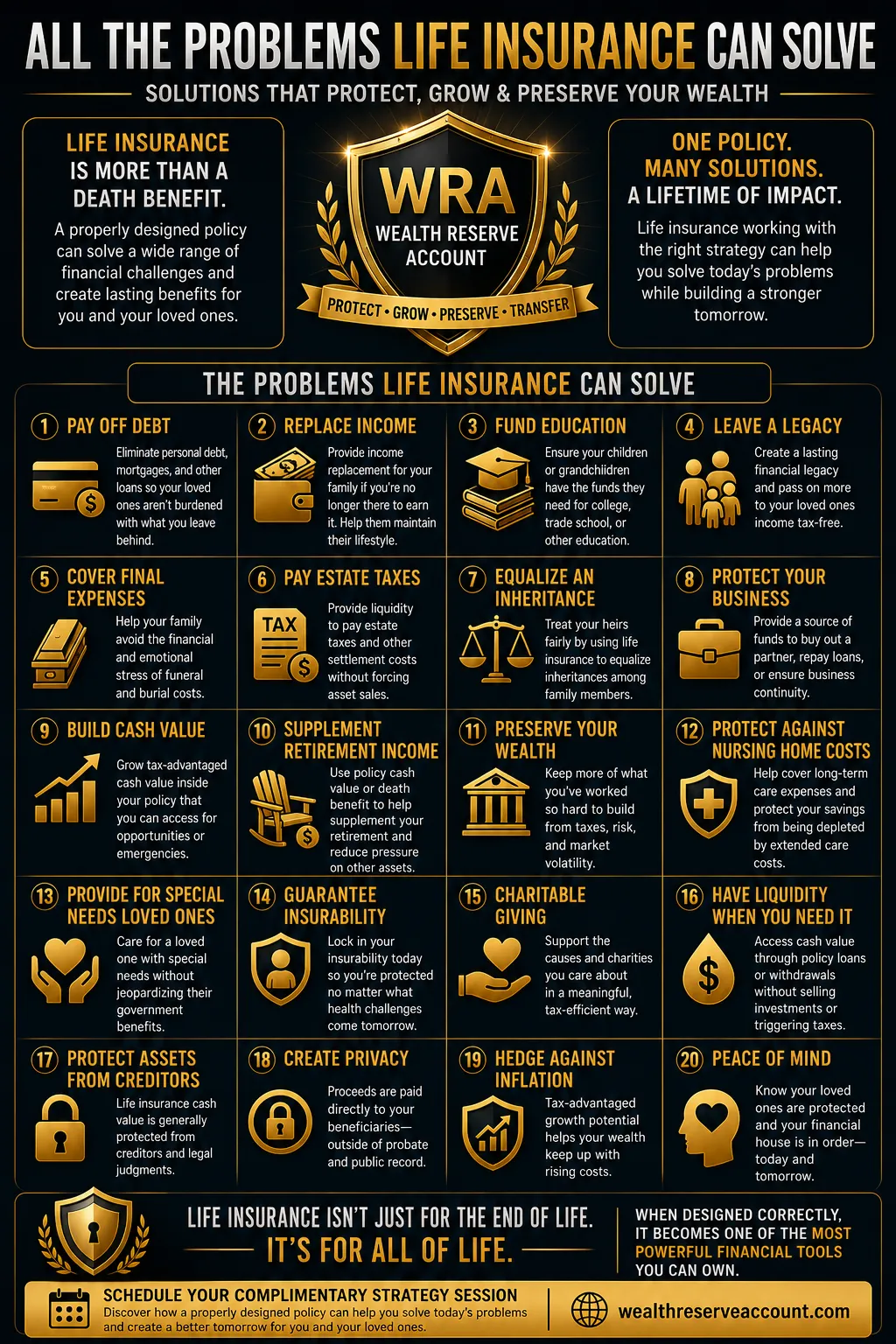

20 Financial Problems a Wealth Reserve Account Can Help Solve
Did you know that certain types of life insurance can do much more than simply provide a death benefit?
A properly designed Wealth Reserve Account, or WRA, can potentially combine permanent life insurance protection with cash value accumulation, liquidity, policy-loan access, tax advantages, and long-term legacy planning.
The WRA is built using a specially designed whole life insurance policy, typically with a dividend-paying mutual insurance company and designed with an emphasis on high cash value.
One policy can potentially solve many financial problems and create a lifetime of impact.
What Is a Wealth Reserve Account?
A Wealth Reserve Account (WRA) is a whole life insurance strategy designed around:
- Permanent death benefit protection
- Guaranteed contractual cash value
- Potential dividends
- Paid-up additions
- Policy-loan access
- Liquidity
- Tax-advantaged growth
- Legacy planning
- Long-term financial flexibility
When properly designed and funded, a WRA can potentially serve multiple purposes throughout your lifetime.
Life Insurance Is Not Just for the End of Life
Most people think of life insurance only as money that is paid when someone dies.
That is still one of its most important purposes.
But permanent whole life insurance can also create value during your lifetime.
PROTECT → BUILD → ACCESS → DEPLOY → PRESERVE → TRANSFER
Protect your family and income.
Build contractual cash value.
Access available capital.
Deploy capital toward financial needs and opportunities.
Preserve long-term wealth.
Transfer a legacy to future generations.
20 Problems a Wealth Reserve Account Can Help Solve
1. Pay Off and Restructure Debt
A Wealth Reserve Account may potentially be used as part of a broader debt-elimination or debt-restructuring strategy.
Once sufficient cash value exists, policy-loan proceeds may be used to pay down or eliminate higher-cost debt.
The objective is not simply to move debt from one place to another, but to improve cash-flow efficiency.
HIGH-INTEREST DEBT → POLICY LOAN → FREED CASH FLOW → REPAY & REPLENISH
As higher-cost debt is eliminated, the cash flow that was previously going toward those payments may potentially be redirected toward repaying the policy loan and rebuilding your reserve.
I refer to this concept as a Debt-to-Wealth Transfer.
What Is a Debt-to-Wealth Transfer?
A Debt-to-Wealth Transfer is the process of redirecting cash flow that was previously being consumed by debt toward building long-term financial assets and reserves.
Instead of:
INCOME → DEBT PAYMENT → MONEY GONE
The goal is to move toward:
INCOME → DEBT ELIMINATION → FREED CASH FLOW → ASSET BUILDING
The goal is not simply to eliminate debt. The goal is to redirect former debt payments toward building wealth.
2. Replace Lost Income
Income replacement is one of the fundamental purposes of life insurance.
Ask yourself:
If something happened to me today, how many years could my family continue living without my income?
If the answer is not long enough, then adequate life insurance protection may need to become a priority.
The death benefit can help surviving family members maintain their lifestyle, pay bills, eliminate debts, and continue moving forward financially.
In situations where permanent whole life coverage is not yet affordable, convertible term life insurance may potentially provide a lower-cost starting point while preserving the ability to transition toward permanent coverage later, subject to the policy's conversion provisions.
3. Fund Education
A Wealth Reserve Account may also be considered as part of a broader college or education-funding strategy.
Policy-loan proceeds generally are not restricted to one specific category of education expenses.
Available capital may potentially be used for:
- College tuition
- Trade school
- Housing
- Books
- Transportation
- Graduate school
- Starting a business
- Other education-related needs
This flexibility may be valuable if a child receives a scholarship, chooses a different type of school, or does not need the money for tuition.
Education-specific accounts and life insurance have different costs, tax rules, and advantages, so they should be compared based on your family's actual goals.
4. Leave a Legacy
Permanent life insurance can create a death benefit designed to transfer wealth to beneficiaries.
Under current federal tax law, life insurance death benefits are generally received income-tax-free by beneficiaries, subject to applicable exceptions.
A broader legacy strategy may also integrate:
- Trust planning
- Estate planning
- Family governance
- Family financial education
- A Family Constitution
- Generational wealth planning
Instead of simply leaving money, the goal can be to leave both wealth and instructions for how that wealth should be preserved.
Life Insurance, Trusts, and the Family Constitution
Depending on your estate-planning strategy, a trust may potentially be named as the beneficiary of a life insurance policy.
The trust can then govern how proceeds are distributed according to the terms established in the trust document.
A broader family legacy strategy may also include a Family Constitution that defines principles, expectations, rules, responsibilities, and values around family wealth.
LIFE INSURANCE → TRUST → FAMILY RULES → FUTURE GENERATIONS
Trust and beneficiary structures can create significant legal and tax consequences and should be coordinated with qualified estate-planning and tax professionals.
5. Cover Final Expenses
Life insurance can help prevent surviving family members from having to immediately come up with money for funeral and burial expenses.
Final expenses may include:
- Funeral costs
- Burial or cremation
- Memorial services
- Medical bills
- Outstanding household obligations
Having adequate death benefit protection can allow loved ones to focus more on grieving and less on financial stress.
6. Provide Estate Liquidity
Life insurance may provide liquidity when an estate needs cash.
Depending on the estate, funds may be needed for:
- Estate taxes
- Debts
- Professional fees
- Settlement costs
- Business obligations
- Other estate expenses
Life insurance proceeds may help reduce the need to sell other assets simply to create liquidity.
7. Equalize an Inheritance
Life insurance may be used to help create a more balanced inheritance among heirs.
For example, one child may inherit a family business or a piece of real estate while another receives life insurance proceeds.
This can provide another way to create fairness without forcing the family to divide or liquidate a major asset.
8. Protect Your Business
Life insurance can play an important role in business continuity planning.
Potential applications include:
- Key-person insurance
- Buy-sell agreement funding
- Business debt protection
- Succession planning
- Ownership transition
If an owner or key person dies, life insurance proceeds may provide the capital needed to keep the business operating, repay obligations, or complete an ownership transition.
Key-Person Insurance
A key person is someone whose death could create a significant financial loss for a company.
This may include:
- An owner
- A founder
- A senior executive
- A top salesperson
- A technical expert
- Another employee critical to the business
A business may own life insurance on that individual and receive the death benefit if the insured key person dies, subject to applicable legal and tax requirements.
Buy-Sell Agreement Funding
Life insurance is also commonly considered when funding certain buy-sell agreements.
A buy-sell agreement can establish what happens to an owner's business interest after a triggering event such as death.
Life insurance may provide funds that help the business or remaining owners purchase the deceased owner's interest according to the agreement.
9. Build Cash Value
One of the defining features of whole life insurance is contractual cash value.
A properly designed WRA places additional emphasis on accumulating cash value and may use paid-up additions (PUAs) to increase both cash value and death benefit.
The policy contains guaranteed values, and participating policies may also receive non-guaranteed dividends when declared by the insurance company.
What Are Paid-Up Additions?
Paid-up additions, or PUAs, are additional fully paid-up amounts of whole life insurance purchased within the policy structure.
PUAs can increase:
- Cash value
- Death benefit
- Long-term compounding potential
Dividends may also be used to purchase paid-up additions, depending on the dividend option selected.
Dividends are not guaranteed.
10. Supplement Retirement Income
A seasoned whole life policy may potentially provide another source of liquidity during retirement.
Policy values may potentially be accessed for:
- Travel
- Bucket-list experiences
- Home care
- Unexpected expenses
- Healthcare costs
- General retirement cash flow
A Wealth Reserve Account should generally be viewed as one component of a broader retirement plan rather than the only retirement strategy.
Tax-Advantaged Retirement Access
Cash value in life insurance generally grows on a tax-deferred basis.
Properly managed withdrawals and policy loans may also provide tax-advantaged access to policy values.
However, taxation can change if a policy becomes a Modified Endowment Contract, lapses with a taxable gain, is surrendered, or is otherwise improperly managed.
Retirement distributions from life insurance should therefore be designed and monitored carefully.
11. Preserve Wealth
A Wealth Reserve Account can provide a financial asset that is not directly invested in the stock market.
Whole life policies include contractual guarantees and may provide non-guaranteed dividends when declared by the insurer.
This can provide another layer of diversification alongside investments, real estate, businesses, retirement accounts, and other assets.
The objective is not necessarily to replace investments, but to maintain a portion of wealth in an asset designed for stability, protection, liquidity, and long-term accumulation.
12. Help Address Long-Term Care and Extended Care Costs
Extended care and nursing-home costs can significantly affect retirement assets.
Depending on the specific policy and riders available, life insurance may potentially provide access to benefits during certain qualifying chronic illness or long-term care events.
In other situations, accumulated cash value may provide additional liquidity for care expenses.
Availability and eligibility vary by policy and carrier.
13. Provide for a Loved One With Special Needs
Life insurance can potentially play an important role in planning for a loved one with special needs.
A properly structured plan may help provide resources while coordinating with government-benefit eligibility.
This is often accomplished through specialized estate planning, such as a special needs trust.
Because government-benefit rules can be complex, this type of planning should be coordinated with an attorney experienced in special needs planning.
14. Protect Your Insurability
Your health can change.
Purchasing life insurance while you are healthy can help lock in your current insurability and policy classification.
This can be especially important for individuals who expect their financial responsibilities to grow over time.
For someone who cannot yet fund the permanent policy they ultimately want, convertible term insurance may potentially provide a bridge toward permanent coverage later, subject to the contract's conversion rules.
Convertible Term as a Bridge to Permanent Insurance
Convertible term life insurance provides temporary death benefit protection with the contractual ability to convert eligible coverage into permanent insurance during the conversion period.
A qualifying conversion may generally occur without new medical underwriting, subject to the terms of the specific policy.
This can allow someone to:
- Protect their family today
- Lock in insurability
- Keep initial premiums more affordable
- Build cash flow over time
- Transition toward permanent whole life coverage later
15. Support Charitable Giving
Life insurance can potentially be incorporated into charitable and philanthropic planning.
An individual may choose to:
- Name a charity as a beneficiary
- Leave a percentage of the death benefit to charity
- Coordinate life insurance with a broader charitable estate plan
This can create a meaningful legacy for organizations and causes that matter to you.
16. Create Liquidity When You Need It
Liquidity is one of the most important benefits of a properly designed WRA.
Cash value may potentially serve as part of your:
- Emergency fund
- Opportunity fund
- Business reserve
- Real estate reserve
- Major purchase fund
Rather than being forced to sell investments or other assets when capital is needed, a policy owner may potentially access available cash value through policy loans.
How Policy Loans Work
A policy loan is generally a loan from the insurance company secured by the policy's cash value.
Policy loans typically do not require conventional credit underwriting.
Depending on the policy, they may also provide flexible repayment provisions.
However, policy loans accrue interest.
Outstanding loans can reduce available cash value and death benefits, and excessive borrowing can create policy-management and tax risks.
17. Potential Creditor Protection
Life insurance cash values and death benefits may receive certain protections from creditors under state law.
The level and type of protection varies significantly by state, policy ownership, beneficiary structure, and individual circumstances.
This should always be verified with qualified legal and insurance professionals familiar with the laws of your state.
18. Create Privacy and Avoid Probate for Named Beneficiaries
When a valid beneficiary is named, life insurance death benefits are generally paid directly to that beneficiary rather than passing through probate.
This can potentially:
- Speed up access to proceeds
- Reduce probate involvement
- Create greater privacy
- Provide liquidity directly to beneficiaries
Trust planning may provide additional control over how proceeds are ultimately managed and distributed.
19. Help Protect Purchasing Power Over Time
Inflation reduces the purchasing power of money over time.
A properly designed whole life policy includes contractual cash-value growth and may also receive dividends when declared by the insurance company.
Reinvesting dividends into paid-up additions can potentially increase cash value and death benefit over time.
However, neither dividends nor the ability of policy values to outpace inflation are guaranteed.
The policy should be evaluated based on its actual guaranteed and non-guaranteed illustration values rather than assuming a specific future rate of return.
20. Create Financial Peace of Mind
Financial peace of mind comes from knowing that important areas of your financial life have been intentionally addressed.
A properly designed life insurance strategy may help you know that:
- Your family has protection
- Your income has been considered
- Your debts can be addressed
- Your beneficiaries have a legacy
- You are building long-term reserves
- You may have access to liquidity when needed
The goal is to put your financial house in order for both today and tomorrow.
What Makes a WRA Different From Traditional Savings?
A traditional savings account and a Wealth Reserve Account are fundamentally different financial tools.
A savings account is generally designed primarily for:
- Cash storage
- Short-term liquidity
- Bank deposit protection within applicable limits
A Wealth Reserve Account is built around permanent life insurance and may combine:
- Death benefit protection
- Contractual cash value
- Potential dividends
- Paid-up additions
- Policy-loan access
- Long-term tax advantages
- Legacy planning
- Business planning
- Estate planning
The appropriate amount to place in each depends on your goals, liquidity needs, risk tolerance, time horizon, and overall financial plan.
What About Guaranteed Interest and Dividends?
Whole life insurance includes contractual guarantees when the policy is properly funded according to its terms.
Participating whole life policies may also receive dividends from the insurance company.
However:
Dividends are not guaranteed.
An illustration may show both:
- Guaranteed policy values
- Non-guaranteed policy values based on the current dividend scale
Illustrated values should not be interpreted as a guaranteed annual investment return.
What Does Tax-Advantaged Growth Mean?
Cash value in life insurance generally grows on a tax-deferred basis.
This means policy owners generally are not paying annual income tax simply because cash value increased during the year.
Policy loans are also generally not treated as taxable income while the policy remains properly structured and in force.
Tax consequences may arise if the policy:
- Becomes a Modified Endowment Contract
- Lapses with a taxable gain
- Is surrendered
- Is improperly managed
Policy design and management therefore matter.
The Bigger Strategy
The real power of a Wealth Reserve Account is not any single feature.
It is the ability to potentially combine multiple financial functions inside one coordinated strategy.
Protect your family.
Replace income.
Eliminate debt.
Build cash value.
Maintain liquidity.
Fund opportunities.
Support your business.
Supplement retirement.
Preserve wealth.
Transfer a legacy.
This is why life insurance should not be viewed only as something for the end of life.
When properly designed, it can potentially become a financial tool that serves you throughout your life.
The Wealth Reserve Account Formula
PROTECT → BUILD → ACCESS → DEPLOY → REPLENISH → PRESERVE → TRANSFER
Protect your income, family, business, and future.
Build contractual cash value.
Access available capital.
Deploy capital toward debt, education, business, retirement, or other opportunities.
Replenish your reserve when appropriate.
Preserve long-term financial value.
Transfer a legacy to future generations.
Frequently Asked Questions
Can whole life insurance really build cash value?
Yes.
Whole life insurance includes contractual cash values when properly funded according to the policy terms.
Are whole life dividends guaranteed?
No.
Participating whole life policies may receive dividends when declared by the insurance company, but dividends are not guaranteed.
Can I use my WRA to pay off debt?
Policy-loan proceeds may generally be used for debt repayment.
Whether this is financially beneficial depends on your existing interest rates, policy-loan rate, cash flow, and repayment strategy.
Can I use my WRA for college?
Available policy-loan proceeds may potentially be used for tuition, housing, books, transportation, or other education-related needs.
Can I use my WRA for retirement?
A seasoned cash-value policy may potentially become one source of retirement liquidity alongside other retirement assets.
Can I use my WRA for business planning?
Potentially.
Life insurance may play a role in key-person protection, buy-sell agreements, business continuity, liquidity, and other business-planning strategies.
Can a trust be the beneficiary?
Potentially, yes.
Trusts may be used in conjunction with life insurance for estate, legacy, and wealth-transfer planning.
Do life insurance proceeds avoid probate?
Death benefits paid to a valid named beneficiary generally pass directly to that beneficiary rather than through probate.
Are policy loans tax-free?
Policy loans generally are not treated as taxable income while the policy remains properly structured and in force.
However, a lapse, surrender, or Modified Endowment Contract can change the tax treatment.
Can life insurance protect assets from creditors?
Certain life insurance values may receive creditor protection under state law, but the rules vary significantly by state and circumstances.
Can life insurance help with special needs planning?
Yes, life insurance may potentially be incorporated into a special needs estate plan, often in coordination with a properly structured special needs trust.
The Bottom Line
Life insurance is not only about what happens when you die.
A properly designed Wealth Reserve Account may potentially help you:
- Pay off or restructure debt
- Replace income
- Fund education
- Leave a legacy
- Cover final expenses
- Provide estate liquidity
- Equalize inheritances
- Protect a business
- Build cash value
- Supplement retirement income
- Preserve wealth
- Address extended-care costs
- Provide for special needs loved ones
- Protect insurability
- Support charitable giving
- Create liquidity
- Potentially receive creditor protection
- Create privacy and avoid probate for named beneficiaries
- Help protect purchasing power
- Create financial peace of mind
Life insurance isn't just for the end of your life. When designed correctly, it can potentially become a financial tool for all of your life.
What Would a Wealth Reserve Account Look Like for You?
A Wealth Reserve Account should be designed around your individual protection needs, cash flow, financial goals, and ability to qualify.
Your personalized design may consider:
- Your age
- Your health
- Your income
- Your cash flow
- Your debt
- Your desired death benefit
- Your emergency-fund goals
- Your education goals
- Your business needs
- Your retirement goals
- Your legacy goals
Schedule Your Wealth Reserve Design & Review
If you would like to see an illustration of a Wealth Reserve Account or explore whether convertible term life insurance may be a better starting point, schedule a complimentary call.
Visit WealthReserveAccount.com to learn more and schedule your appointment.
Topics Covered in This Video
Wealth Reserve Account, WRA, whole life insurance, high cash value whole life insurance, dividend-paying mutual insurance company, cash value life insurance, guaranteed cash value, whole life dividends, paid-up additions, PUAs, tax-advantaged growth, tax-deferred cash value, policy loans, borrowing against cash value, Debt-to-Wealth Transfer, debt elimination, debt payoff, debt restructuring, mortgage payoff, income replacement, family protection, convertible term life insurance, guaranteed insurability, college funding, education funding, legacy planning, generational wealth, Legacy Generation System, trust planning, Family Constitution, family banking, final expenses, funeral expenses, burial costs, estate taxes, estate liquidity, inheritance equalization, business protection, key-person insurance, key-man insurance, buy-sell agreements, business continuity, business succession planning, retirement income, retirement planning, tax-advantaged retirement income, wealth preservation, market volatility, long-term care, nursing home costs, chronic illness planning, special needs planning, special needs trust, charitable giving, charitable beneficiary, emergency fund, opportunity fund, liquidity, private capital reserves, creditor protection, asset protection, probate avoidance, privacy, beneficiary planning, inflation protection, purchasing power, permanent life insurance, tax-free death benefit, family legacy, estate planning, financial security, financial control, financial velocity, wealth transfer, protect capital, access capital, preserve wealth, and generational legacy.