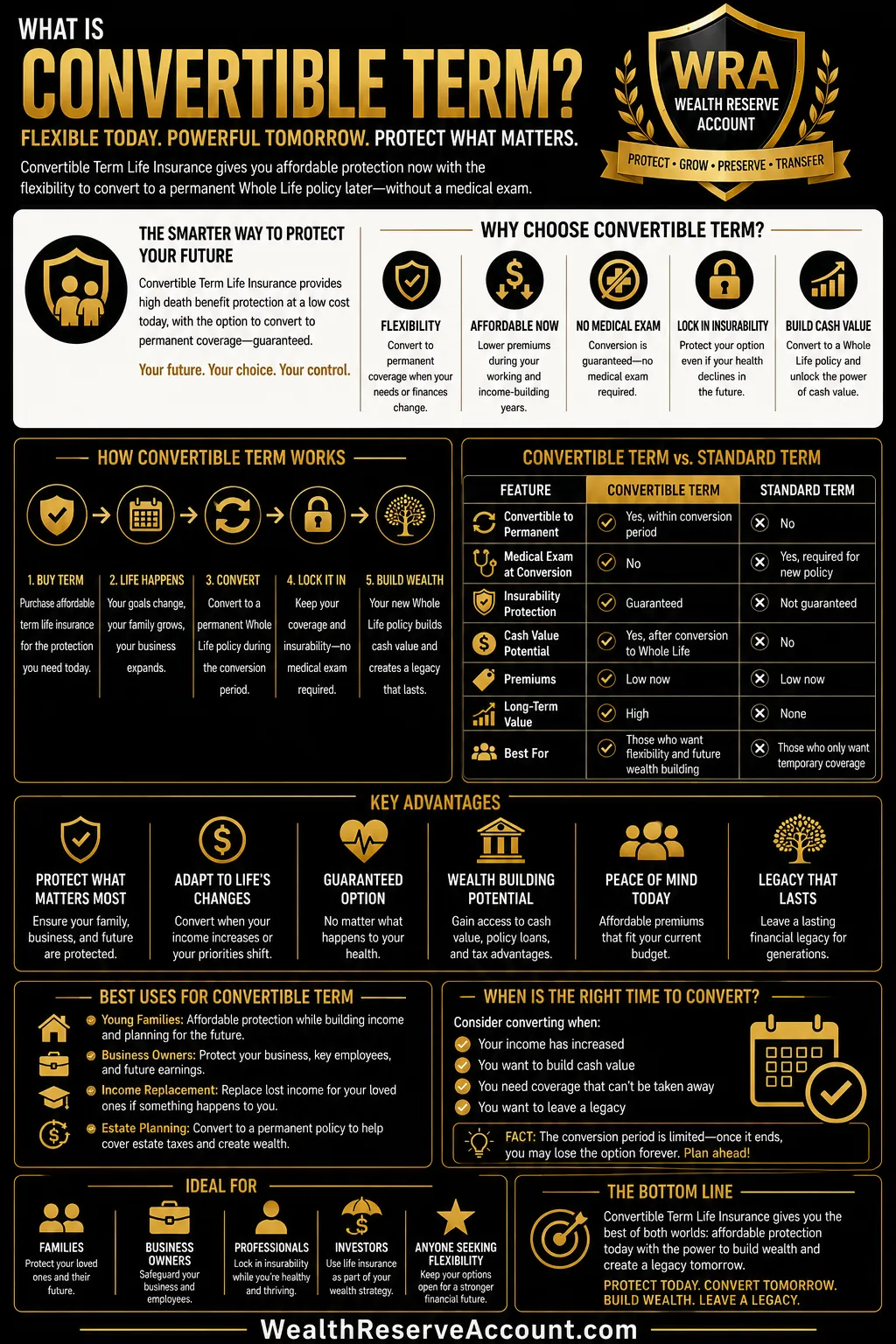

Convertible Term Life Insurance: Protect Today, Build Your Wealth Reserve Account Tomorrow
If you want to establish a Wealth Reserve Account (WRA) using a high-cash-value whole life insurance policy, but you don't currently have enough cash flow to fund the policy the way you would like, convertible term life insurance may provide a place to start.
Convertible term life insurance can allow you to:
- Obtain affordable life insurance protection today
- Lock in your current insurability
- Protect your family, income, business, and future earning potential
- Convert your coverage into permanent whole life insurance later
- Potentially convert without going through new medical underwriting
- Gradually transition toward a Wealth Reserve Account strategy as your cash flow increases
The key is understanding that protection comes first.
What Is a Wealth Reserve Account (WRA)?
A Wealth Reserve Account, or WRA, is a whole life insurance policy with a dividend-paying mutual insurance company that is specifically designed for high cash value.
The strategy uses paid-up additions (PUAs) to increase cash value and death benefit. As the policy develops, cash value can provide a financial reserve that may be accessed through policy loans.
A properly designed WRA can potentially serve multiple financial purposes:
- Emergency Fund: Create reserves for unexpected expenses and life events.
- Opportunity Fund: Maintain accessible capital that can potentially be deployed when investment, business, or other opportunities arise.
- Business Capital: Use accumulated policy cash value as a potential source of liquidity for business needs.
- Retirement Planning: Build cash value that may become part of a broader retirement-income strategy.
- College Planning: Create another potential source of capital for education expenses.
- Legacy Planning: Maintain permanent life insurance protection while building cash value and leaving a death benefit for future generations.
The ultimate objective is to establish a financial foundation that combines protection, liquidity, cash value accumulation, and legacy planning.
What If You Cannot Afford to Properly Fund a WRA Yet?
This is where we go back to the fundamental purpose of life insurance:
Protection.
Ask yourself:
If something happened to me today, how many years could my family continue living without my income?
If the answer is not long enough, protecting your family's financial future may need to come before maximizing cash accumulation.
You are one of your greatest financial assets.
Your future earning potential over the next 10, 20, 30, or even 40 years can represent millions of dollars of economic value to your family.
That is why the first objective should be to protect your potential net worth and income.
A Wealth Reserve Account can be an important financial strategy, but there are situations where someone may need substantially more death benefit than they can currently afford through permanent whole life insurance alone.
That's where convertible term life insurance can become useful.
What Is Convertible Term Life Insurance?
Convertible term life insurance provides temporary life insurance protection with an important additional feature:
The ability to convert eligible term coverage into permanent life insurance during the policy's conversion period.
Depending on the policy and insurance carrier, convertible term coverage may be available for periods such as:
- 5 years
- 10 years
- 15 years
- 20 years
- 30 years
The conversion feature can allow you to transition some or all of the eligible coverage into permanent insurance without going through new medical underwriting, subject to the policy's conversion provisions.
This can be especially valuable if your health changes in the future.
Instead of waiting until you can afford the permanent policy you ultimately want, you can potentially protect your insurability today and build toward permanent coverage over time.
Why Convertible Term Can Be a Bridge to a Wealth Reserve Account
Imagine that you want a high-cash-value whole life policy, but your current budget does not allow you to fund it at the level you would like.
Rather than ignoring your protection needs while waiting for your income to increase, you could potentially purchase convertible term insurance today.
Later, as your:
- Income increases
- Cash flow improves
- Business grows
- Debt decreases
- Financial priorities change
...you may be able to convert eligible coverage into permanent whole life insurance.
PROTECT → GROW → CONVERT → BUILD
1. Protect Today
Purchase affordable life insurance protection based on your current needs.
2. Grow Your Cash Flow
Continue increasing income, improving financial efficiency, reducing unnecessary debt, and building financial capacity.
3. Convert When Appropriate
During the applicable conversion period, convert eligible term coverage into permanent insurance according to the policy's provisions.
4. Build Your Wealth Reserve
Once permanent whole life coverage is established and appropriately designed, begin building cash value, paid-up additions, and your long-term financial reserve.
How Convertible Term Life Insurance Works
Step 1: Buy Term Coverage
Purchase affordable term life insurance designed to provide the amount of protection you need today.
The objective is to protect your:
- Family
- Income
- Business
- Future earnings
- Financial obligations
- Legacy
Step 2: Life Happens
Over time, things change.
- Your family may grow.
- Your income may increase.
- Your business may expand.
- Your priorities may change.
- Your financial position may improve.
Step 3: Convert to Permanent Coverage
During the conversion period, you may choose to convert eligible term insurance into a permanent life insurance policy.
One of the major benefits of conversion is that it can generally be done without new medical underwriting, subject to the specific policy's contractual conversion provisions.
Step 4: Begin Building Permanent Value
Once converted into an appropriately designed whole life policy, the new permanent policy can begin building cash value while providing permanent death benefit protection.
That permanent policy can potentially become part of your Wealth Reserve Account strategy.
You May Not Have to Convert Everything at Once
One of the most useful features of some convertible term policies is the ability to convert portions of the coverage over time, subject to the carrier's rules and the policy contract.
For example, suppose you purchased:
$1,000,000 of Convertible Term Life Insurance
Instead of converting the entire $1 million at once, you might potentially convert portions over time.
- Conversion #1: $200,000–$300,000
- Conversion #2: Another $200,000–$300,000 several years later
- Conversion #3: Another portion later
Over time, you could potentially transition more of the original term coverage into permanent policies as your financial capacity increases.
This can create multiple permanent policies rather than requiring you to fund the entire permanent insurance strategy at once.
Convertible Term vs. Standard Term Life Insurance
Convertible Term
Convertible term provides temporary death benefit protection plus a contractual conversion option.
During the applicable conversion period, eligible coverage may be converted into permanent insurance according to the carrier's rules.
Standard Non-Convertible Term
A non-convertible term policy provides temporary coverage for a specified period.
Once the term ends, you may have to:
- Allow the coverage to terminate
- Continue coverage at significantly higher renewal rates, if available
- Apply for new insurance
- Go through underwriting again
If your health has changed, obtaining new coverage could become more difficult or expensive.
That makes the conversion privilege potentially valuable.
What About Return-of-Premium Term Insurance?
Return-of-premium term insurance is another variation of term coverage.
With this type of policy, some or all eligible premiums may be returned if contractual requirements are satisfied and the insured survives the applicable term.
However, receiving premiums back does not automatically provide permanent life insurance coverage.
That is an important distinction.
If your objective is eventually establishing permanent insurance and building a Wealth Reserve Account, the ability to convert coverage may be more aligned with that long-term objective than simply receiving premiums back.
6 Key Advantages of Convertible Term Life Insurance
1. Affordable Protection Today
Term insurance generally provides substantial death benefit protection at a lower initial premium than permanent whole life insurance.
2. Protect Your Insurability
The conversion privilege may allow eligible coverage to be converted without new medical underwriting.
3. Flexibility as Your Finances Change
You don't necessarily have to be financially ready for your complete permanent insurance strategy today. Your income and cash flow may increase over time.
4. Potential Transition to Permanent Coverage
When the time is right, eligible term coverage can potentially be converted into permanent life insurance.
5. Potential Future Cash Value
Term insurance itself does not generally build cash value. However, once eligible coverage is converted into an appropriately designed permanent whole life policy, that new policy can begin accumulating cash value.
6. Long-Term Legacy Planning
Permanent insurance can ultimately provide lifetime death benefit protection, subject to policy terms and sufficient funding, while creating an asset designed to transfer wealth to beneficiaries.
Protect Your Potential Net Worth
One of the most important concepts in life insurance planning is recognizing the economic value of your future income.
How much income could you potentially earn during the remainder of your working life?
If you earn $100,000 annually for another 30 years, that represents:
$3,000,000 of Potential Future Gross Income
That doesn't mean everyone automatically qualifies for $3 million of life insurance. Life insurance companies have financial underwriting guidelines that determine how much coverage someone may qualify for.
But it demonstrates an important principle:
Your future earning potential may be one of your family's largest financial assets.
Life insurance helps protect that economic value if your life ends prematurely.
Who May Benefit From Convertible Term Life Insurance?
Young Families
Families who need substantial protection today but are still building income and savings.
Protect now. Build income. Convert later.
Business Owners
Convertible term can potentially be used as part of planning for:
- Business protection
- Key-person coverage
- Buy-sell planning
- Income replacement
- Future permanent insurance needs
Professionals
Professionals whose income is expected to increase substantially over time may want protection today while preserving the opportunity to transition toward permanent coverage later.
Investors
Investors may want substantial death benefit protection today while building the financial capacity to establish permanent cash-value strategies in the future.
Families Focused on Income Replacement
Life insurance can help replace income that would otherwise disappear if a primary income earner died prematurely.
Estate and Legacy Planning
Permanent life insurance can potentially play a role in estate liquidity, legacy creation, and wealth transfer. Convertible term can provide a path toward that permanent coverage.
When Is the Right Time to Convert?
Conversion may become more attractive when:
- Your income has increased
- Your cash flow has improved
- You want to begin building cash value
- Your business has grown
- You want permanent life insurance protection
- Your legacy-planning needs have increased
- You are approaching the end of your conversion period
One of the most important things to remember:
The conversion period is limited.
Every policy and insurance carrier can have different conversion rules. Some policies may permit conversion for much or all of the term period, while others may limit conversion based on a specific number of years, age, product availability, or other contractual provisions.
That's why you should understand the conversion provisions before purchasing the policy.
Can You Have a WRA and Convertible Term at the Same Time?
Yes. Depending on your needs and ability to qualify, the strategy does not necessarily have to be either/or.
Strategy #1: Wealth Reserve Account + Convertible Term
The Wealth Reserve Account can begin establishing your permanent cash-value strategy.
The convertible term policy can provide additional death benefit protection that might otherwise be too expensive to purchase entirely through permanent insurance today.
As your financial capacity increases, eligible portions of the convertible term coverage may potentially be converted into additional permanent insurance.
Strategy #2: Convertible Term First → Wealth Reserve Account Later
If cash flow is limited today, you may decide to focus first on affordable protection and then establish your Wealth Reserve Account as your financial position improves.
The appropriate approach depends on your protection needs, income, cash flow, health, insurability, objectives, and overall financial strategy.
The Bigger Strategy: Protection Before Accumulation
It can be tempting to focus immediately on:
- Cash value
- Policy loans
- Dividends
- Paid-up additions
- Banking strategies
- Retirement income
- Wealth accumulation
But the original purpose of life insurance remains extremely important:
Protect the people who depend on you.
Before asking:
"How much cash value can I build?"
Consider asking:
"If I died tomorrow, would my family have enough financial protection?"
The goal is to build a strategy where protection and wealth accumulation complement one another.
Convertible Term + WRA: The Long-Term Vision
TODAY — Protect
Protect your family, income, business, and potential net worth.
NEXT — Grow
Increase your income and improve your cash flow.
THEN — Convert
Convert eligible coverage into permanent whole life insurance as appropriate.
LONG TERM — Build
Build cash value, paid-up additions, policy liquidity, permanent death benefit protection, and legacy.
This is why convertible term can be an important starting point for someone who believes in the Wealth Reserve Account strategy but isn't financially ready to fully implement it yet.
Key Terms to Know
Convertible Term Life Insurance
Temporary life insurance that includes a contractual option to convert eligible coverage into permanent insurance during a specified conversion period.
Whole Life Insurance
Permanent life insurance designed to provide lifetime coverage and contractual cash values when properly funded according to the policy.
Wealth Reserve Account (WRA)
A strategy using a specially designed whole life insurance policy from a dividend-paying mutual insurance company, structured with an emphasis on cash value and long-term financial flexibility.
Paid-Up Additions (PUAs)
Additional fully paid-up life insurance purchased within a whole life policy structure that can increase both cash value and death benefit.
Cash Value
Value accumulated inside a permanent life insurance policy that may be accessible according to the policy's provisions.
Policy Loan
A loan from the insurance company secured by the policy's cash value. Policy loans accrue interest and can affect cash value and death benefits if not properly managed.
Death Benefit
The amount payable to beneficiaries upon the insured's death, subject to the terms of the policy.
Conversion Period
The contractual period during which eligible term insurance can be converted into permanent coverage.
Insurability
An insurance company's assessment of whether and under what terms it is willing to insure an individual.
Dividend-Paying Mutual Insurance Company
A mutual life insurance company may pay dividends to eligible participating policyholders. Dividends are not guaranteed.
Frequently Asked Questions About Convertible Term Life Insurance
Does convertible term life insurance build cash value?
No. Term life insurance itself generally does not accumulate cash value. The opportunity for cash-value accumulation begins after eligible coverage is converted into an appropriate permanent life insurance policy.
Do I need another medical exam when I convert?
A qualifying contractual conversion generally allows eligible coverage to be converted without new medical underwriting, subject to the specific terms of your policy.
Always review the actual conversion provisions of the policy you are considering.
Do I have to convert the entire policy at once?
Not necessarily. Some policies allow partial conversions, meaning you may be able to convert portions of the death benefit at different times. Carrier and policy rules vary.
How long do I have to convert?
It depends on the insurance company and the specific policy. Conversion periods can vary significantly, so this should be reviewed before purchasing coverage.
What happens if I don't convert?
If you reach the end of the applicable conversion period without exercising the option, you may lose the ability to convert that coverage.
The term insurance itself may eventually expire or become renewable under different premium terms depending on the contract.
Can I start a Wealth Reserve Account now and also purchase convertible term?
Potentially, yes. For some people, combining permanent whole life insurance with additional convertible term protection can provide both a cash-value strategy and a larger amount of affordable death benefit protection.
The Bottom Line
Convertible term life insurance can provide affordable protection today while preserving an opportunity to transition into permanent coverage tomorrow.
If you want to establish a Wealth Reserve Account but don't currently have enough cash flow to fund the permanent coverage you ultimately want, convertible term may provide a strategic starting point.
The objective is to create a progression:
- Protect your income.
- Protect your family.
- Protect your potential net worth.
- Increase your financial capacity.
- Build permanent value.
- Create a lasting legacy.
Ready to Explore Your Options?
There are three potential approaches worth evaluating:
1. Start With Convertible Term
Get the protection you need today and prepare to convert eligible coverage as your finances grow.
2. Establish a Wealth Reserve Account
Begin building your permanent whole life and cash-value strategy now.
3. Combine Both Strategies
Establish a Wealth Reserve Account while using convertible term insurance to provide additional affordable protection.
The right approach depends on your individual financial situation, protection needs, goals, health, and ability to qualify.
Schedule Your Wealth Reserve Design & Review
Visit WealthReserveAccount.com to schedule a call and explore what a convertible term policy, Wealth Reserve Account, or combination of both could look like for you.
Topics Covered in This Video
Convertible term life insurance, Wealth Reserve Account, WRA, whole life insurance, high cash value life insurance, dividend-paying mutual insurance company, paid-up additions, PUAs, cash value, policy loans, permanent life insurance, term life insurance, convertible term vs. standard term, return-of-premium term, life insurance conversion, medical underwriting, insurability, income replacement, family protection, business protection, key-person insurance, retirement planning, estate planning, legacy planning, emergency fund, opportunity fund, college planning, wealth building, cash flow, death benefit, protecting your net worth, banking strategy, financial planning, and life insurance strategy.